At the Maplewood Apartments project, now under construction, Cornell engineering students will deploy heat-pump monitors to study the system viability in a severe winter climate.
This month two events are raising money to support the Emergency Cornellians Aiding and Responding to Employees (CARE) Fund, which helps Cornell employees experiencing an unexpected major financial crisis.
Researchers at the K. Lisa Yang and Hock E. Tan Institute on Employment and Disability released the Disability Statistics Status Report Jan. 30, revealing 41 million noninstitutionalized people are living with disabilities.
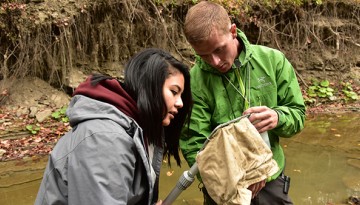
Students in Tom Whitlow’s Restoration Ecology class spent the fall semester examining Lake Treman’s many components, and they worked with the New York State Department of Parks and Recreation to develop a plan for managing it.
An-Chi “Angela” Dai ’15 and Kelly McClure ’16 have been selected to join the third class of Schwarzman Scholars, a program that sends young leaders to Beijing for a year of master’s degree study.