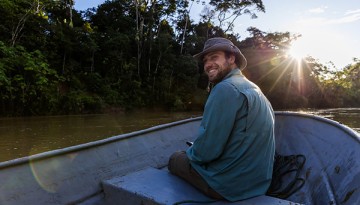
Ethan Duvall, an inaugural Semlitz Family Sustainability Fellow, has launched a nonprofit aimed at protecting biodiversity and culture in the Amazon Rainforest. Among their on-the-ground initiatives, they are working alongside local and Indigenous communities to strengthen green economic initiatives.
Science fiction author, activist and journalist Cory Doctorow will visit Cornell Sept. 11-19 as an A.D. White Professor at Large, taking part in several events on campus and in the community.
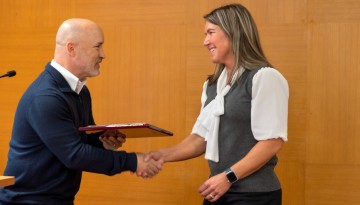
The Employee Assembly presented the award to Adrienne Mason, the administrative director for two departments in the College of Agriculture and Life Sciences, on Aug.29.
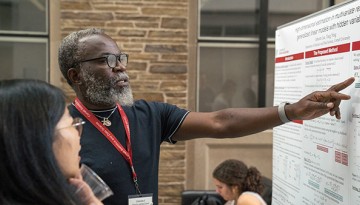
The eighth annual Celebration of Statistics and Data Science features nine speakers and celebrates Cornell’s rich history in statistics, data science, and mathematics.
Best-selling writer and technology blogger Cory Doctorow will make the A.D. White Professor-at-Large program’s second dual-campus visit, ending his week at Cornell Tech in New York City. Four other professors will visit Cornell this fall.
An experimental vineyard at the Cornell Lake Erie Research and Extension Laboratory is becoming the university’s first living laboratory of precision, autonomy and sustainability, supporting the grape industry in New York and Pennsylvania.
A Cornell-led collaboration developed microscale magnetic particles that can mimic the ability of biomolecules to self-assemble into complex structures, while also reducing the parasitic waste that would otherwise clog up production.