The Graduate Diversity and Inclusion Awards recognized members of the graduate community for their impacts on advancing access, engagement and belonging through service and leadership.
Brad Ramshaw, associate professor of physics, has been named to the 2025 class of Brown Investigators. Each investigator, recognized for curiosity-driven research in chemistry or physics, will receive up to $2 million over five years.
A computer model analysis showed that global adoption of regenerative farming practices to improve soil health can benefit either greenhouse gas mitigation or crop yields but rarely both.
Researchers in the Cornell SC Johnson College of Business found that consumers tend to overestimate fractional star ratings and underestimate fractional Arabic numerals. In either case, the ratings can be misleading.
The Roper Center for Public Opinion Research has announced its 2025 student fellows. This year’s cohort includes the W.E.B. Du Bois Fellow and three Kohut Fellows. These emerging scholars will advance data-driven research by contributing original scholarly work that uses Roper iPoll’s extensive survey archive.
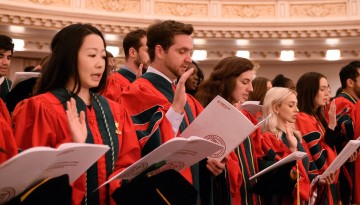
A total of 450 expected graduates in the Class of 2025 received their degrees from Weill Cornell Medicine during the institution’s annual Commencement ceremony, held May 15 at Carnegie Hall.
Héctor Abruña, the Émile M. Chamot Professor of Chemistry and Chemical Biology, is honored for his pivotal contributions to understanding electrochemical processes.