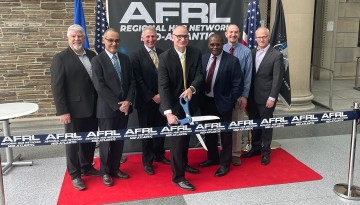
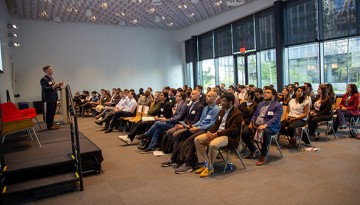
The event included a ribbon-cutting ceremony, remarks from AFRL Chief Technology Officer Dr. Timothy Bunning, and presentations from researchers who received funding during the Fall 2022 funding cycle.
New research from Cornell and the Smithsonian Institution deepens the geological understanding of Earth’s continents by testing and ultimately eliminating a popular hypothesis about why continental and oceanic crusts have contrasting compositions.
Valerie Reyna will lead Cornell's contribution in developing new artificial intelligence technologies designed to promote trust and mitigate risks, while simultaneously empowering and educating the public.
Quantum electrodynamics can explain the puzzling first observations of polarized X-rays emitted by a neutron star with a powerful magnetic field, according to a Cornell astrophysicist.
Cornell is one of six universities receiving a total of $20 million over five years to form an institute aiming to create more climate-smart practices that will curb greenhouse gas emissions while boosting the agriculture and forestry industries.
Cornell Engineering has announced the winners of its seventh annual Engineering Innovation Competition, which recognizes innovative product concepts and prototypes from students.
Big Red Ventures (BRV), Cornell’s early-stage venture capital fund, showcased the student-run portfolio and highlighted 2022-23 investments during the Annual Meeting on April 20 at Cornell Tech.
While upstate New Yorkers are evenly split on utility-scale solar farms, naysayers object partly due to a perception that rural residents unfairly bear the burden of meeting downstate urban energy demands without compensation, a survey has found.