Radio interview looks at the mission of the Latino Civic Association of Tompkins County, and the highly diverse and complex Latinx community in Tompkins and the surrounding region.
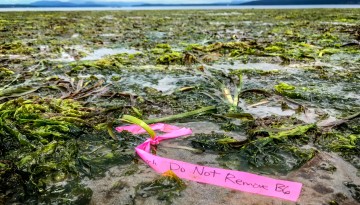
In an oceanic omen for climate change’s intensifying effects, Cornell-led research shows that seagrass suffers from a wasting disease and root-system deterioration.
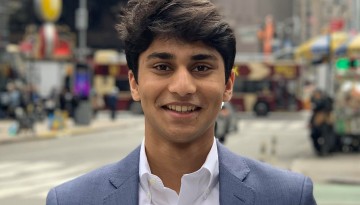
Aadi Kulkarni ’22 received a prestigious George J. Mitchell Scholarship to pursue a master’s degree in social data analytics at University College Dublin next year.
A research team led by Leslie Lok, assistant professor in the College of Architecture, Art and Planning, relied on mixed-reality technology to design and assemble the installation utilizing salvaged barn wood and hollow-core construction.
Teddy was diagnosed with the most common type of cancer for dogs: Lymphoma, a blood cancer that starts in the lymph nodes and can infiltrate any organ in the body, including the eyes.
A new predictive model shows that once political polarization becomes too extreme, people won't be able to unite even in the face of a challenge that threatens society's survival.
A new Mann Library exhibit, “Cultivating Silence: Nikolai Vavilov and the Suppression of Science in the Modern Era,” pays tribute to pioneering plant scientist Nikolai Vavilov and serves as a reminder of the threat of political censorship and persecution.
Shaheer (Shawn) Haq ‘21, Daniel James II ’22 and Xiaochen (Brian) Ren ‘22 were elected to join the seventh cohort of Schwarzman Scholars, a program that nurtures a network of future global leaders.
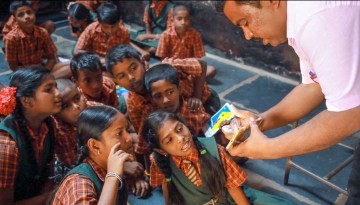
Rama Adithya Varanasi, a Ph.D. candidate in the field of information science, spent six months studying hundreds of teachers in rural and urban communities to understand how different aspects of smartphone use and governance were causing significant technology-related stress.