Thanks to Cornell researchers and their colleagues, a dataset of thousands of experiments is publicly available, providing insight into fields like political science, communication, psychology, marketing, organizational behavior, statistics, computer science and education.
The Royal Liverpool Philharmonic Orchestra will launch its 2021-22 season on Oct. 14 with the world premiere of “Symphony No. 6,” composed by Roberto Sierra, the Old Dominion Foundation Professor in the Humanities in the College of Arts and Sciences.
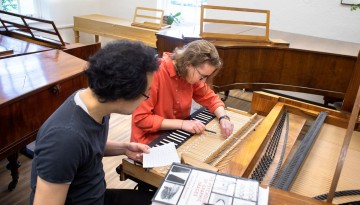
An undergraduate, Elizaveta Zabelina ’24, is teaming up with a music department faculty member to create an illustrated catalog and guide to the instruments that are part of Cornell's historical keyboard collection.
In a new book, “Policymaker’s Journal,” Kaushik Basu offers musings about economic policymaking and public life during his years serving as chief economic adviser in India’s finance ministry and chief economist at the World Bank.
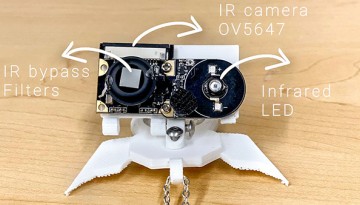
Tracking facial movements, and possibly their cause, is one of the proposed applications for NeckFace, a necklace-type wearable sensing technology developed in the lab of Cheng Zhang, assistant professor of information science.
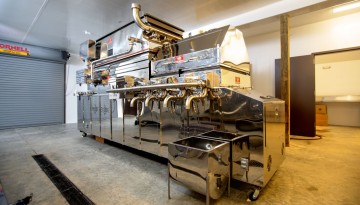
The Cornell Maple Program has opened an advanced, New York state-funded maple research laboratory, an upgrade that will enable research on making high-quality syrup, and new and existing maple products – all at commercial scales.
Todd Bittner, Director of Natural Areas, Cornell Botanic Gardens, and member of Dryden Rail Trail Task Force discussing how the Dryden Rail Trail "connects communities" in Tompkins County.