Scientists have engineered a key plant enzyme and introduced it in Escherichia coli bacteria in order to create an optimal experimental environment for studying how to speed up photosynthesis, a holy grail for improving crop yields.
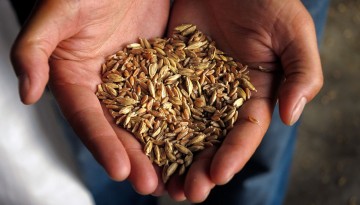
A Cornell scientist is leading a multi-institution team that’s helping turn diverse and ancient grains into staple foods throughout the Northeast and Midwest, thanks to a three-year, $2 million grant from the U.S. Department of Agriculture.
The history of superconducting materials has been a tale of two types: s-wave and d-wave. Now, Cornell researchers have discovered a possible third type: g-wave.
Eduardo M. Peñalver ’94, the Allan R. Tessler Dean of Cornell Law School, reflects on the life and career of Supreme Court Justice Ruth Bader Ginsburg ’54, who died Friday at age 87.
Ruth Bader Ginsburg ’54, whose legal career in the fight for women’s rights, equal rights and human dignity culminated with her ascent to the U.S. Supreme Court, died Sept. 18 in Washington, D.C. She was 87.
The NSF has awarded a $1.5 million grant for Cornell researchers to study the health dangers, changes in the lake food web and socioeconomic challenges when these algal blooms produce toxins.
Four faculty experts kicked off the College of Arts and Sciences’ yearlong “Racism in America” webinar series with a Sept. 16 discussion about policing and incarceration.