Cornell is helping six New York state schools use high tunnels to grow their school gardens and studying how they benefit the schools' educational programs. (Oct. 26, 2011)
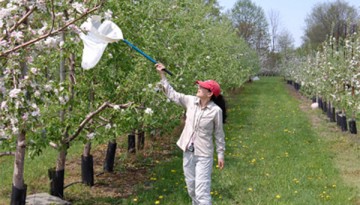
Native bees are better pollinators and more plentiful than honeybees, finds entomologist Bryan Danforth, who is involved in two big projects to further study native bee populations.
Using a genomic approach, a Cornell team has developed a test that can precisely pinpoint the exact nature and origin of food-borne bacteria with unprecedented accuracy. (Oct. 24, 2011)
At an Oct. 19 meeting of the Southern Tier Regional Economic Development Council, which he co-chairs, President David Skorton expressed optimism for the economic future of New York state. (Oct. 20, 2011)
With the first continuous slow pyrolysis unit built at a U.S. university, a research team are on the cusp of harnessing the power of organic material to fuel an entire village in Kenya. (Oct. 18, 2011)
Researchers have received almost half a million dollars to fight the invasive brown marmorated stink bug, which has the potential to destroy New York's crops.