Cornell faculty are reaching across disciplines to tackle society’s most complex challenges and to make breakthrough discoveries. These radical collaborations—collisions of thoughts and perspectives from vastly different fields—lead to unexpected and unconventional solutions and deepen our thinking.

Migrations initiative announces cross-campus awards

Cornell faculty members are finding answers to questions related to a world on the move with a boost from Cornell’s first Migrations grants, awarded by the “Migrations” Global Grand Challenge.

NYC Visioning projects host cross-campus events

The four faculty teams that received funding support through the President’s Visioning Committee on Cornell in New York City have conducted cross-campus workshops, hosted interdisciplinary talks and expanded their outreach.

Study: Infectious gut bacteria may predict UTI risk

Urinary tract infections in kidney transplant patients may be caused by bacteria that originate in the digestive tract, according to researchers at Weill Cornell Medicine.

Spending time in nature reduces stress, research finds

New research from an interdisciplinary Cornell team has found that it takes as few as 10 minutes in a natural setting for college students to feel happier and lessen the effects of stress both physically and mentally.

Quadrupling turbines, U.S. can meet 2030 wind-energy goals

The United States could generate 20% of its electricity via wind energy within 10 years according to new Cornell research.

Physics tool helps track cancer cell diversity

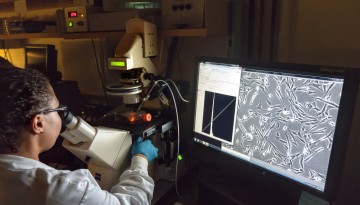
A Cornell-led team took an interdisciplinary approach to analyzing the behavior of breast tumor cells by employing a statistical modeling technique more commonly used in physics and economics.

Top ag schools joining forces at Cornell digital ag hackathon

Students and faculty from the world’s five leading agricultural universities, including Cornell, will spend three days learning and brainstorming at the Cornell Initiative for Digital Agriculture’s second annual hackathon, Feb. 28-March 1.

Consider workplace AI’s impact before it’s too late, study says

If we want to have a say in what the future looks like, scholars and policymakers need to start thinking about workplace automation far more broadly, according to a new paper co-authored by a Cornell researcher.

Cornell co-leads effort to use big data to combat catastrophes

An NSF-funded initiative, co-led by professor David S. Matteson, aims to harness data across disciplines in order to identify risk factors for catastrophic events.