Cornell faculty are reaching across disciplines to tackle society’s most complex challenges and to make breakthrough discoveries. These radical collaborations—collisions of thoughts and perspectives from vastly different fields—lead to unexpected and unconventional solutions and deepen our thinking.

Project to examine digital agriculture from many angles

Jaron Porciello in the Department of Global Development is exploring barriers to the widespread adoption of digital agriculture tools through a grant from USAID and the Bill & Melinda Gates Foundation.

NSF funding to help erase upstate NY’s digital divide

The NSF has awarded $1.5 million to Cornell engineers to help bridge New York’s digital divide by designing the nation’s first statewide Internet of Things public infrastructure.

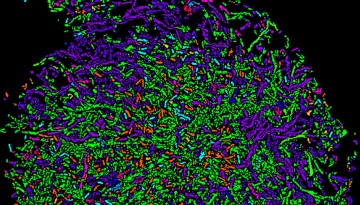
Study reveals possible new coronavirus entry points

Research from the Feschotte Lab identifies 28 new SARS-CoV-2 and coronavirus associated receptors and factors that predict which tissues are most vulnerable to infection.

NSF funds effort to support home health aides through tech

An interdisciplinary team of Cornell researchers has been awarded a grant from the National Science Foundation to develop technological tools to ease the burdens on home health aides.

Laser jolts microscopic electronic robots into motion

A Cornell-led collaboration has created the first microscopic robots that incorporate semiconductor components, allowing them to be controlled – and made to walk – with standard electronic signals.

Deadline to apply for Klarman postdoc fellowship is Oct. 15

Applications are being accepted through Oct. 15 for the second cohort of the Klarman Postdoctoral Fellowship program, in the College of Arts and Sciences.

Graphene sensors find subtleties in magnetic fields

Cornell researchers used an ultrathin graphene “sandwich” to create a tiny magnetic field sensor that can operate over a greater temperature range than previous sensors, while also detecting miniscule changes in magnetic fields that might otherwise get lost within a larger magnetic background.

Researchers create nanoclusters that mimic biomolecules

Cornell researchers discovered a way to bind and stack nanoscale clusters of copper molecules that can self-assemble and mimic complex biosystem structures at different length scales.

Study: Machine learning can predict market behavior

Machine learning can assess the effectiveness of mathematical tools used to predict the movements of financial markets, according to new Cornell research.