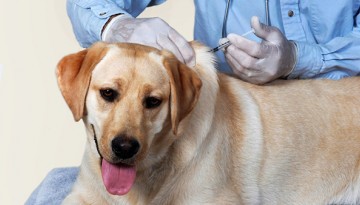
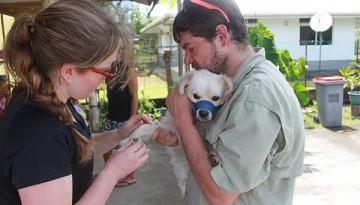
A highly visible dog ear tag to mark and monitor treated and untreated strays is being developed by Cornell engineering and fiber science faculty though the Atkinson Center for a Sustainable Future.
For the first time, a litter of puppies was born by in vitro fertilization, thanks to work by Cornell researchers. The breakthrough opens the door for conserving endangered canid species and using gene-editing technologies to eradicate heritable diseases.
Scientists at Cornell’s Baker Institute for Animal Health have developed a device that helps diagnose stroke in less than 10 minutes using a drop of blood barely big enough to moisten your fingertip.
College of Veterinary Medicine professor Dr. Robin Radcliffe is raising local awareness of two vanishing rhino species in Indonesia via a book for Indonesian children, “The Hornless Rhinoceros."
Two Cornell professors emeriti of veterinary medicine have received the 2015 Ezra Technology Innovator Award for their work as co-inventors of the Marek's disease vaccine.
Provost Michael Kotlikoff has called for proposals for feasibility and planning grants for academic programs that span the Ithaca and Cornell Tech campuses. The deadline to submit proposals is Jan. 22, 2016.
Village dogs from present-day Nepal and Mongolia are direct descendants of the first domesticated dogs, which originated at least 15,000 years ago in that region, a new study reports.
George C. Poppensiek, dean and professor emeritus in the College of Veterinary Medicine, died Sept. 8 in Ithaca. Poppensiek served as dean from 1959 to 1974.