On 4-H National Youth Science Day Oct. 5, young people nationwide will undertake an interactive engineering design challenge created by Cornell Cooperative Extension and the National 4-H Council.
Each year $160 billion worth of wasted food ends up in America's landfills. A Cornell economist has received a two-year, $500,000 USDA grant to get consumers and food distributors to squander less.
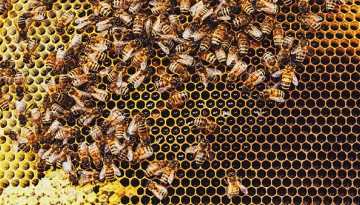
A team led by Cornell researchers has received a five-year, $2.2 million National Institutes of Health grant to better understand how pathogens that infect bees and other pollinators are spread.
eHub opened earlier this month in Kennedy Hall and houses the offices of Entrepreneurship at Cornell and Blackstone LaunchPad for use by students, faculty and staff interested in entrepreneurship.
Cornell researchers use a SIRT6 mutant to identify which of the sirtuin's enzymatic activities contributes to its defatty-acylation, contributing to understanding of the protein's various functions.
The Colman Leadership Program, hosted by the Office of Inclusion and Student Engagement and Diversity Programs in Engineering, offered personal exploration to 26 Ph.D. students in all fields of study June 14-18.
For the first time, Cornell researchers report they have identified biological markers of chronic fatigue syndrome in gut bacteria and inflammatory microbial agents in the blood.
Gannett Health Services is opening its new addition, with a temporary main entrance on Campus Road. Services will be provided in the new facility while the original 60-year-old building undergoes renovation.
Faculty members Harold van Es, Carla Gomes and Joshua Woodard will present their innovative research at the intersection of computation, food and sustainability at the World Economic Forum June 26-28 in Tianjin, China.
More than one-third of families in large metropolitan areas now live in neighborhoods of concentrated affluence or concentrated poverty, and middle-class neighborhoods have become less common, says sociologist Kendra Bischoff.