Faculty members Harold van Es, Carla Gomes and Joshua Woodard will present their innovative research at the intersection of computation, food and sustainability at the World Economic Forum June 26-28 in Tianjin, China.
More than one-third of families in large metropolitan areas now live in neighborhoods of concentrated affluence or concentrated poverty, and middle-class neighborhoods have become less common, says sociologist Kendra Bischoff.
Scientists will discuss ways to use computer power to solve problems in ecology and conservation at the Fourth International Conference on Computational Sustainability, July 6-8.
Twenty percent of people living in nursing homes are abused by other residents, according to a study by researchers in the College of Human Ecology and Weill Cornell Medicine.
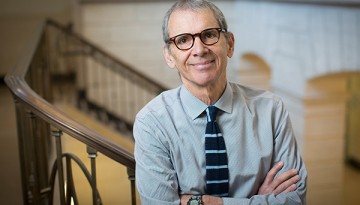
Kent Hubbell, B.Arch. '69, is returning to the architecture faculty after serving for 15 years as Cornell's dean of students, a tenure marked by his concern and support for students' well-being.
Fungi that live in a healthy gut may be as important for good health as beneficial intestinal bacteria, according to new research conducted at Weill Cornell Medicine.
A naturally produced chemical exacerbates infection by a common bacteria, rendering the infection significantly harder for the body to clear, according to new Cornell cross-campus research.
Professor Tapan Mitra has established annual prizes benefiting students in the Department of Economics with a $100,000 endowment, as a “concrete expression of my continuing attachment to this great institution of learning.”
Spanning six continents, 32 countries and 54 cities, more than 12,000 samples of DNA, RNA and microbes from surfaces in subways, buses, airports and other well-traveled public meeting spaces were collected June 21.
A faculty member since 1983, McLaughlin is senior associate director of the Dyson School. He will become Dyson's interim David J. Nolan Dean starting July 1, Provost Michael Kotlikoff announced.