Continuing an effort to reduce its carbon footprint, Cornell University is proposing a 10-acre solar farm on university property in the town of Seneca, New York, where the university conducts agricultural research.
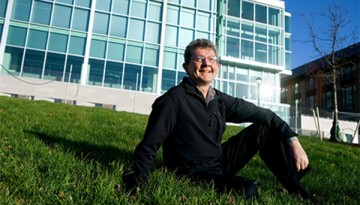
Physicist Séamus Davis has received a $2 million, five-year grant to explore new ways to study “quantum materials” like superconductors, superfluids and whatever comes next.
Researchers have discovered that patches of waterlogged soil in forested watersheds act as hot spots of microbial activity that remove nitrogen from groundwater and return it to the atmosphere.
“Expanded Communities and Posthumanity” will feature scholars from a wide range of disciplines exploring the field of posthumanities on campus Nov. 5-6.
Robert F. Engle, M.S. ’66, Ph.D. ‘69, who won the 2003 Nobel Memorial Prize in Economic Sciences, spoke on campus Oct. 24 about economics models that can stave off another financial crisis.
Artist Chon Noriega, curator of a 1993 Arts Quad exhibition that led to the takeover of Day Hall by Latino students, recalled the events in a campus talk Oct. 28.
A first clinical trial of ultrasmall, multifunctional particles called "C dots" (Cornell dots) has deemed them safe for humans and cleared easily by the body.
“Firing the Canon,” a College of Arts and Sciences sesquicentennial exhibit, explores how Cornell’s prized collection of plaster casts was “embraced, defaced and dethroned.”