Researchers from the Cornell Lab of Ornithology and the Institute for Computational Sustainability are using big data and AI to model hidden patterns in nature – not just for one bird species, but for entire ecological communities across continents.
A team of Cornell computer scientists has been awarded a $3 million grant from the Defense Advanced Research Projects Agency to leverage reinforcement learning to make computer networks stronger, dynamic and more secure.
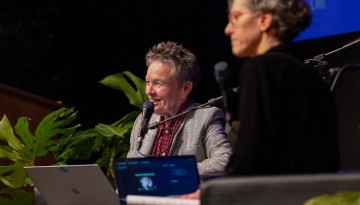
Multimedia artist Laurie Anderson took a captivated Cornell audience on a trip through the arc of her career during a Sept. 26 talk at the Schwartz Center for the Performing Arts.
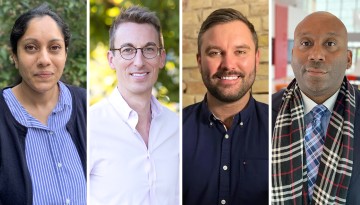
Four new faculty bring expertise in a broad range of policy areas, including health care, contemporary security, the economics of education, social policy and inequality, demography, criminology, and development economics.
Vesna Bacheva, recipient of a 2023 Schmidt Science Fellowship, collaborates with CROPPS to pioneer innovative technologies and models aimed at investigating the signaling and nutrient transport processes within plants.
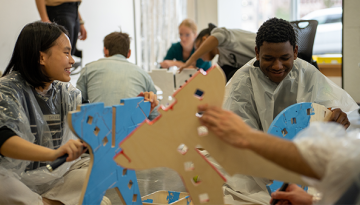
"Junior Architects: Building Disciplinary Transformation Through Education," this semester's Preston H. Thomas Memorial Symposium, takes a deep look at achieving enduring diversity in design education and practice through a re-evaluation of the student experience.
Israel Cidon, former dean of the Andrew and Erna Viterbi Faculty of Electrical and Computer Engineering at Technion-Israel Institute of Technology, has joined Cornell Tech as director of the Joan and Irwin Jacobs Technion-Cornell Institute.
The College of Human Ecology has received a $13.5 million gift commitment to support cross-college design research and collaboration across disciplines.
New research by Assistant Professor Evan Riehl shows that affirmative action can have benefits for students from disadvantaged backgrounds but also unintended spillover effects that negatively impact a university's other students.
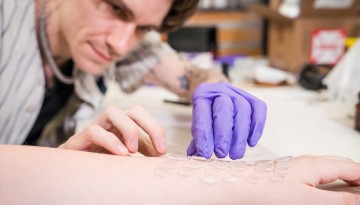
Joe George was the artist-in-residence this summer in the Hybrid Body Lab, where Cindy Hsin-Liu Kao combines digital technology, fashion design and body art to invent beautiful, functional computer interfaces that people can wear on their skin.