A team of Cornell researchers have found new complexities in the superfluid state of liquid helium with implications for the study of superconductivity and theoretical models of the origin of the universe.
A deeper understanding of the brain’s connectivity network of neurons and its relationship to the organ’s deep tissue could allow recognition of what processes relate to neurological disorders.
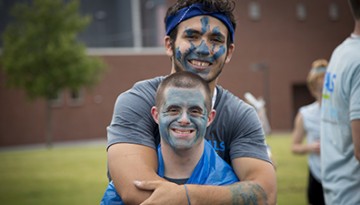
Thirty-eight young adults with Down syndrome came to Cornell June 25 through July 1 for the second annual Camp PALS New York, which gives campers and counselors a chance to build relationships.
An ambitious project that deploys big data and uses machine learning to understand the ecological impacts of hydropower dams in the Amazon Basin started in a mundane enough setting: on the sidelines at youth baseball games.
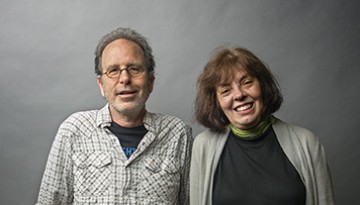
Researchers Louisa Smieska and Ruth Mullett are advancing studies of medieval illuminated manuscripts with X-ray imaging at CHESS of the pigment trace elements found in pages in Cornell collections.
A study in which participants were given two choices - healthy and unhealthy - shows that the process by which we make decisions involving temptation is dynamic as opposed to sequential.
A material strong enough to protect the intestines from a needle puncture and bendable enough to insert through a laparotomy incision that quickly dissolves in the body is being studied.
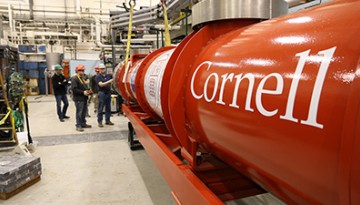
With CBETA, the Cornell-Brookhaven ERL Test Accelerator, scientists are following up on the concept of energy-recovering particle accelerators first introduced at Cornell more than 50 years ago.
A group of five Cornell researchers - representing Engineering, and Arts and Sciences - has won a $1 million grant from the Keck Foundation for its research into topological superconductors.
Physics professor Erich Mueller and grad student Shovan Dutta realize long-theorized quantum state in an array of solitons, which could pave the way for future study into the creation of such states.
A Student Assembly resolution has led to a substantive improvement for students: Faculty can now make course syllabi available online before students enroll in classes. The syllabi are on Cornell's official Class Roster website.