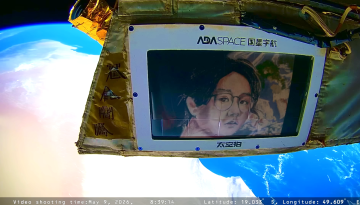
Claire Choi '28 transformed her engineering research into CO2, a space-based artwork exploring humanity's relationship with carbon dioxide that was selected for the Xu Bing Space Art Residency Program and recorded aboard an orbiting satellite.
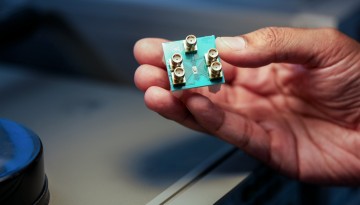
One year after unveiling a first-of-its-kind “microwave brain” microchip capable of computing on ultrafast data and wireless signals, researchers from the Cornell Duffield College of Engineering have shown how the chip can encode information into its own language.
Researchers studying ribosomes, AI and quantum computing are among 13 early-career professors from Cornell who’ve recently been awarded National Science Foundation Faculty Early Career Development Awards.
Light typically interacts with a material the same way whether it enters through the front or the back. Cornell researchers have demonstrated a simple route to breaking that symmetry, with possibilities for photonics and quantum information processing.
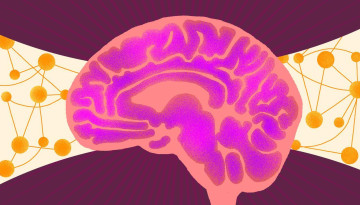
As psychedelic drugs gain more support from the medical community as a potential treatment for severe depression, Cornell researchers are making crucial discoveries that explain how compounds such as psilocybin work on the brain.
A new Cornell study shows how drivers of water shortage, from melting snowpack to growing population demands, may impact Colorado’s West Slope River basins and Lake Powell – a major source of energy and water supply for 40 million people.
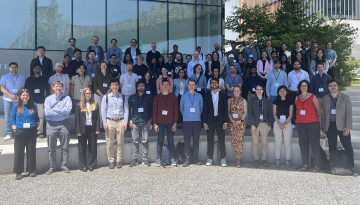
Researchers from around the world gathered at Cornell Tech for a workshop exploring how physics-aware artificial intelligence can accelerate the discovery of molecules and materials while improving the reliability of machine learning models.
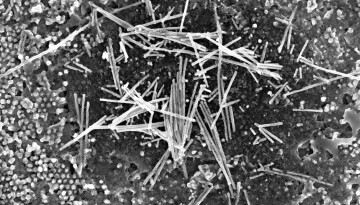
Researchers developed a potential replacement for the tiny copper interconnects in microchips: single-crystal nanowires that become better conductors the thinner they get.