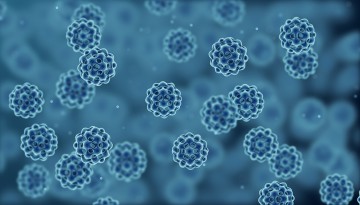
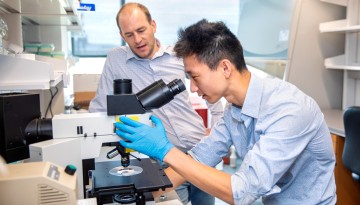
Cornell researchers developed a new way to safely heat up specific areas inside the body by using biodegradable polymers that contain tiny water pockets, a technology that could lead to precise and noninvasive diagnostics and therapeutics.
Staff members were honored at the 69th Annual Service Recognition Event, held June 2 in the Schurman Hall Atrium at the College of Veterinary Medicine.
Cornell geochemists and synthetic biologists have collaborated to improve the efficiency of microbes that can dissolve rocks to extract critical minerals while speeding carbon sequestration from air.
An international collaboration that includes Cornell researchers achieved a new level of precision in measuring the magnetic anomaly of the muon – a tiny, elusive particle that could have very big implications for understanding the subatomic world.
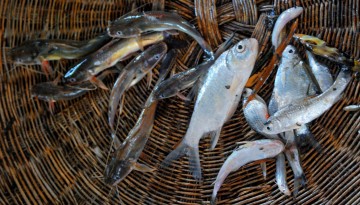
To satisfy the seafood needs of billions of people, offering them access to a more biodiverse array of fish creates opportunities to mix-and-match species to obtain better nutrition from smaller portions of fish.
Savely Senderovich, professor of Russian literature and medieval studies emeritus in the College of Arts and Sciences for more than 30 years, died on April 1 in Clarkstown, New York. He was 89.