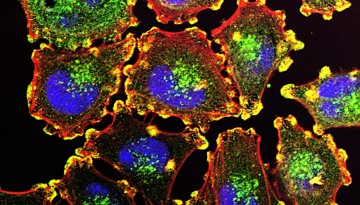
Cornell researchers successfully ramped up the body’s own immune response to fight melanoma at the tail end of a targeted cancer therapy, when tumors commonly become resistant to these treatments.
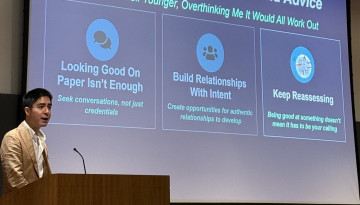
Jason Marvin, Ph.D. ’22, spoke about his journey from biomedical engineering doctorate to his current position during the Summer Success Symposium alumni keynote on Aug. 18.
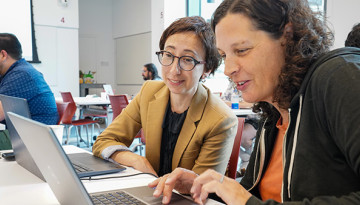
Guided by the vision, "Any Customer, Any Service, One Experience," the Service Management team supports the Cornell Experience Modernization Initiative (CEMI) by identifying opportunities to improve collaboration, visibility, and consistency across service providers.
Cornell engineers have developed a “digital twin” framework that creates a real-time virtual representation of urban carbon dioxide conditions, creating a tool that could help city planners monitor emissions, identify hotspots and evaluate potential interventions before implementing them in the real world.
Prostate tumors can rewire amino acid metabolism to override the normal brakes on cholesterol production, a process that may fuel hormone therapy resistance, according to Weill Cornell Medicine researchers.
Researchers used satellite images to identify 1.8 million trees in New York City, a new approach that could be broadly implemented to increase cooling and improve air quality in cities.
Mary Loeffelholz, dean of the School of Continuing Education who led the school’s expansion post-pandemic and the planning of Cornell’s first part-time online bachelor’s degree program, will step down from her role as dean, effective Jan. 1.
The astronomy department will host a free public astronomy symposium Sept. 17 featuring expert talks on astrobiology, exoplanets, stellar death and cosmic origins. The event will highlights astronomy research and graduate student discoveries.
Service management provides shared practices that help administrative and technology teams deliver, support, and improve services over time. As the Cornell Experience Modernization Initiative (CEMI) works to modernize the university’s administrative systems, the CEMI Service Management team is helping service providers prepare for the changes ahead.
“We Do AI” was the first educational series at Cornell to provide staff across an entire college with advanced training in how to use AI effectively in their daily workflows.
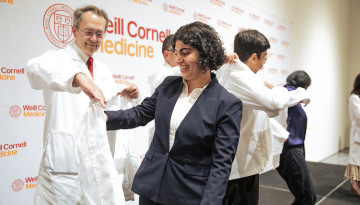
Weill Cornell Medicine celebrated the incoming physician assistant students in the Class of 2028 and first-year medical students in the Class of 2030 Aug. 18 during two White Coat Ceremonies.