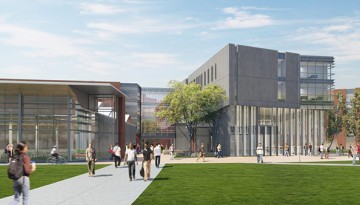
Cornell will name two new North Campus residence halls to honor Justice Ruth Bader Ginsburg ’54 and Nobelist Toni Morrison, M.A. ’55. The university is asking for name ideas on the remaining three buildings.
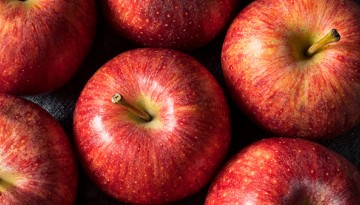
The fabled Silk Road is responsible for one of our favorite and most valuable fruits: the domesticated apple. Researchers have now assembled complete reference genomes and pan-genomes for the apple and its two main wild progenitors.
Amid the clatter in the days before the presidential election, three professors in the College of Arts and Sciences offered a bright light at the end of the 2020 tunnel: hope for democracy.
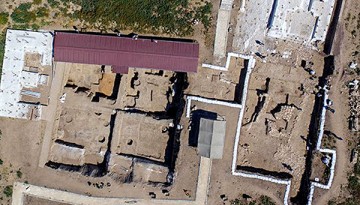
A new study – led by archaeologists from Cornell and from the University of Toronto, working in southeastern Turkey – reveals evidence of resilience and even of a flourishing ancient society despite changes in climate.
After learning the theory and methodology behind public opinion polls, undergraduates in “Taking America’s Pulse” surveyed a nationally representative sample of more than 1,100 Americans on a wide range of topics.
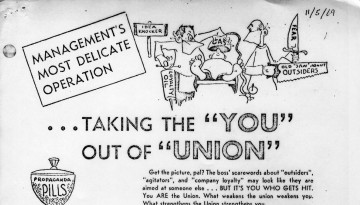
The Kheel Center for Labor-Management Documentation and Archives, in Catherwood Library, recently digitized the anti-union files donated by former HR executive Leonard C. Scott, who specialized in combatting labor unions.
Cornell social scientists were part of a team that won the National Excellence in Multistate Research Award from the Association of Public and Land-Grant Universities and the United States Department of Agriculture.
President Martha E. Pollack and Vice Provost for Undergraduate Education Lisa Nishii discuss getting out to vote, “semi-final” exams during the third and fourth weeks of November, and other topics.
The Institute for African Development has been awarded a U.S. Department of Education grant to strengthen African studies and languages for Cornell undergraduates.
Caitlín Barrett, associate professor of classics in the College of Arts and Sciences, has been named a National Geographic Explorer after receiving a grant from the National Geographic Society to study daily life in ancient Rome.
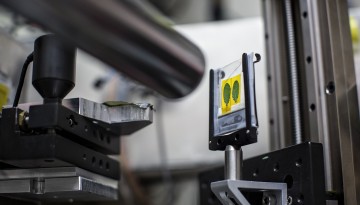
The National Science Foundation has awarded the Cornell High Energy Synchrotron Source $32.6 million to build a High Magnetic Field beamline, which will allow researchers to conduct precision X-ray studies of materials in persistent magnetic fields.