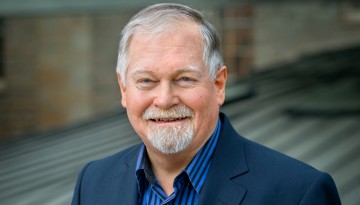
Robert Morgan, an influential American writer and one of Cornell’s most beloved professors, will be honored at a celebration on campus on his 75th birthday.
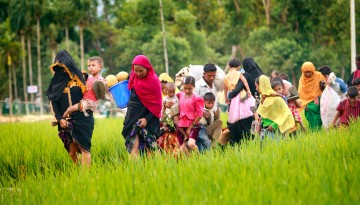
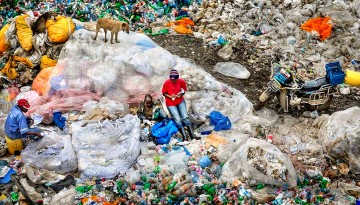
After an eight-month study, a task force of 16 faculty members has chosen “Migrations” as the theme of the first Cornell Global Grand Challenge, which will tackle the issue with resources from across the university.
As the Faculty of Computing and Information Science celebrates its 20th year, Frank Rosenblatt’s prescient research into artificial intelligence underscores Cornell’s pivotal role in computing history.
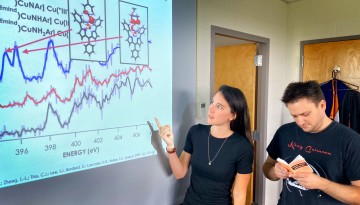
A collaboration between researchers from Cornell, Harvard, Stanford and the SLAC National Accelerator Laboratory has resulted in a reactive copper-nitrene catalyst that pries apart carbon-hydrogen bonds and transforms them into carbon-nitrogen bonds, a crucial building block for chemical synthesis.
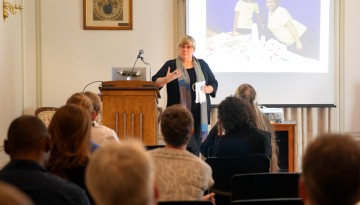
Poetry and performance, as well as more traditional presentations, were among the nine projects highlighted in the first Rural Humanities Showcase, held Sept. 6 in the A.D. White House.
Events this week include a climate rally, talks and films on climate change; a play depicting a soccer team’s coming of age; and a celebration of Korean language and culture.