Allison Hutchison, associate director of the Engineering Communications Program at Cornell Engineering, worked with colleagues and students on a mental model tracking project, to assess and improve student learning through analysis of metacognitive reflection activities.
News directly from Cornell's colleges and centers
CTI grants enable faculty to research how students think and learn
By Carolyn Keller
Assessment and reflection – understanding what students are learning and how they think about learning – are essential to education. But the 2024-2025 Innovative Teaching & Learning Grant projects aim for something even more ambitious: metacognition, the art of thinking about thinking.
From student storytelling and project archiving in the Dyson Grand Challenges program, housed in the Charles H. Dyson School of Applied Economics and Management, part of the Cornell SC Johnson College of Business, to AI-powered reflection in STEM courses, to mental model tracking in engineering communications, the 2024-2025 projects centered around the questions of how students think and learn – and how their thoughts are shaped and expanded upon through the agency of storytelling and the power of metacognitive assessment.
“Improving STEM Learning and Pedagogical Assessment through AI-Powered Personalized Reflection”
- Alexandra Werth, assistant professor in the Meinig School of Biomedical Engineering, Cornell Engineering
- Natasha Holmes, the Ann S. Bowers Associate Professor of Physics, in the Department of Physics, College of Arts and Sciences (A&S).
- Rene Kizilcec, associate professor of information sciences, Cornell Ann S. Bowers College of Computing and Information Science
- Michelle Smith, the Distinguished Professor of Arts & Sciences in the Department of Ecology and Evolutionary Biology, senior associate dean for undergraduate education (A&S)
“Coming into Cornell, one of my research areas is studying authentic learning environments and how we can measure what our key learning objects are in these environments, and often they’re really tough things to measure,” said Alexandra Werth, project lead and discipline-based education researcher in Cornell Engineering.
Werth and her colleagues focused their work on creating an equitable environment for students to work in teams. Previous surveys aimed at measuring teamwork often yielded responses that reflected what students thought faculty wanted to hear, rather than their genuine experience.
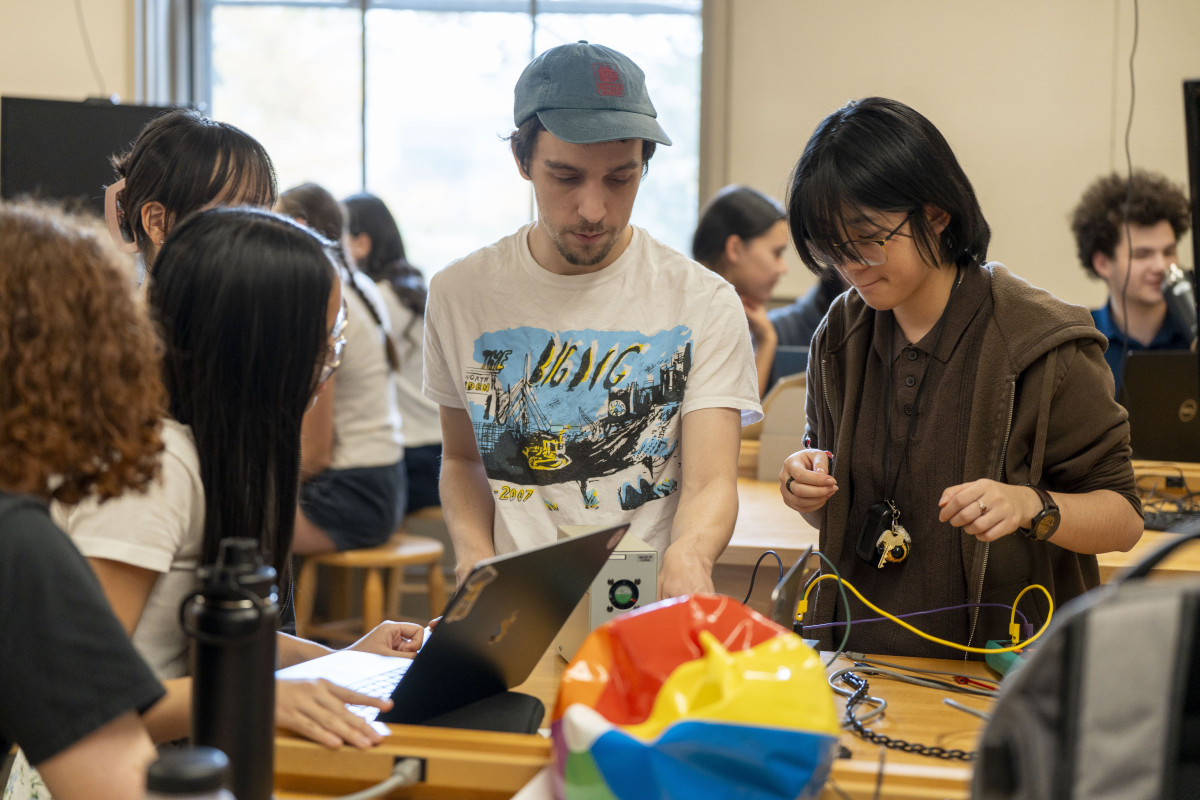
The "Improving STEM Learning and Pedagogical Assessment" innovation project focused on creating an equitable environment for students to work in teams.
“When generative AI rocked the educational space, it was definitely scary,” Werth said. “With my education researcher hat on, I saw this as a really cool opportunity to coach students through the reflective process.”
Werth, Holmes, Kizilcec and Smith developed an AI tool to foster student metacognitive skills around teamwork in STEM classes. They first asked students to reflect on a question, then fed the responses into a generative AI model, which then created a follow-up question that helped students to reflect more deeply.
The team of faculty piloted the tool in Cornell courses with the hopes of scaling it to other courses and disciplines in the future.
“AI isn’t going to solve it all,” Werth said. “I think one place where this tool that we’ve developed is really interesting is that it’s not meant to replace a teacher. It’s not meant to teach a student or to grade or to give the right answer or anything like that. It’s not giving information, it’s asking really good questions.”
“What, So What, and Now What?: Creating strategic touchpoints for critical reflection, project archiving, and impact assessment”
- Sarah Wolfolds, senior lecturer and director of undergraduate studies in the Dyson School, part of the Cornell SC Johnson College of Business
- Lisa Gerber, Grand Challenges program manager in the Dyson School, part of the Cornell SC Johnson College of Business
“What, So What, and Now What?” set a goal of fostering student critical reflection, scaling principles of community-engaged learning, and creating ways for students to share and see examples of other Dyson Grand Challenges projects through a project archive.
The Grand Challenges Program is a required program for all undergraduate students in the Charles H. Dyson School of Applied Economics and Management. Consisting of four courses across four years, it’s designed to demonstrate how students apply their business skills to real-world challenges while addressing one of the United Nations’ 17 Sustainable Development Goals, which range from eliminating world poverty and hunger, to creating paths to clean energy, water and sanitation, to working to promote gender equality and climate actions.
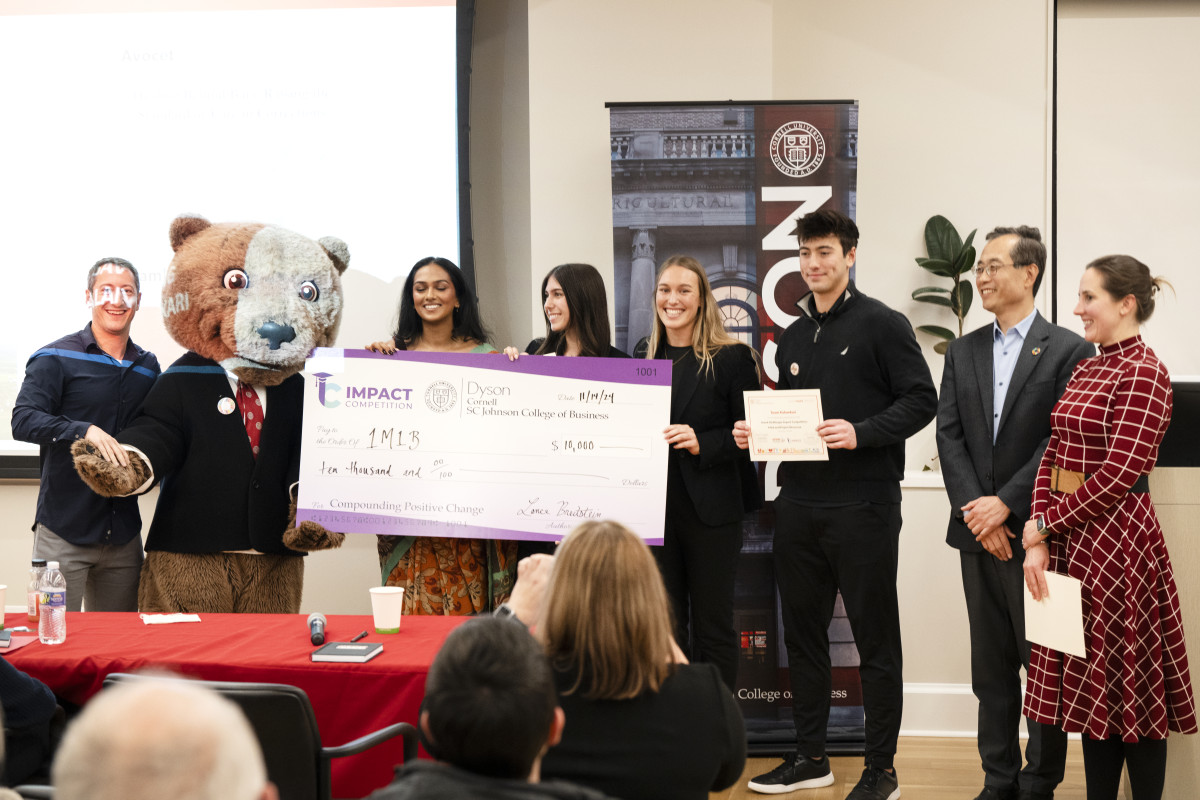
Innovation grant recipients in the Dyson Grand Challenges Program focused on building an archive to amplify the work of students and project partners, including winners of its Impact Competition, above.
With more than 900 students participating in the Grand Challenges Program annually, and more than 230 engaged in team projects that impact them personally and benefit communities both locally and around the world, Wolfolds and Gerber wanted to begin the work of building an archive to amplify the good work and strong relationships between students and project partners.
“One of the key things we really thought about was how to enhance the storytelling for our program. Not just us as a program telling the story, but how do students tell the story of their project work?” Wolfolds said.
That project soon expanded to film projects-in-progress via site visits with the Center for Teaching Innovation media team, and filming the Grand Challenges Impact Competition, a presentation and project showcase held each semester, where students compete for more than $20,000 each semester, with funding going to non-profit organizations aligned with their project.
The Impact Competition is a way to bring the Dyson community together, so that all stakeholders and students could see the breadth of Grand Challenges projects and reflect on the impact of the work. In the spring of 2025, student projects for the Impact Competition included working with a nonprofit focused on sustainability work in the Peruvian Amazon, an Ithaca-based food entrepreneur working to scale his food truck-based passion project into a sustainable business, and a nonprofit in India that sells authentic Kalamkari clothing.
Along the way, students reflected on their projects’ larger contexts, why their work matters within it, and how they would translate their work into future action.
“There was this perception that critical reflection is really difficult to integrate into courses or into projects, but we found that critical reflection can take a lot of forms,” Gerber said. “That could be the project archive, it could be the LinkedIn story. It’s the impact competition. Everything that they’re doing is actually critical reflection. It doesn’t have to be a 10-page essay.”
Gerber noted that the projects go beyond students learning about finance and data analytics to how they can apply their skills in those areas to have a real impact in local communities. Sharing the story of that work is a crucial part of that work, and building critical reflection skills is inherent to that process.
“This project brings student voices to life and shows how meaningful learning can be when it’s shared,” Gerber said.
"Mental Model Tracking Instrument for Assessing and Promoting Student Knowledge through Reflective Writing"
- Cameron Mozafari, senior lecturer in the Engineering Communications Program at Cornell Engineering
- Traci Nathans-Kelly, the Robert N. Noyce Director of the Engineering Communications Program at Cornell Engineering
- Allison Hutchison, associate director of the Engineering Communications Program at Cornell Engineering
The "Mental Model Tracking Instrument" project was rooted in essential questions: How do students learn? When do we realize what we’ve learned? And is there a way to track how that mental process works?
“If you ask anybody what they’ve learned, I think it’s really challenging for them to pinpoint where exactly they learned that thing from,” Hutchison said. “They might remember a specific course, but more than likely it’s going to be something really ingrained.”
With these questions in mind, Mozafari collaborated with Nathans-Kelly and Hutchison, as well as student programmers Luke Shao '26, a computer science major, and Davey Seeman '27, a computer science and math major. The two student programmers to bridge the realms of linguistics and web development and create a mental model tracking tool. That tool can then assess and improve student learning through analysis of metacognitive reflection activities that the students participate in.

Cameron Mozafari, senior lecturer in the Engineering Communications Program, Cornell Engineering, collaborated with colleagues and student programmers to bridge the realms of linguistics and web development to examine how student ways of thinking changed over the course of the semester.
With a background in cognitive and corpus linguistics, Mozafari knew that using the corpus linguistics approach of keyword analysis could be used to determine whether or not students’ ways of thinking were changing as the semester progressed. The approach gathers a corpus of data from which language patterns can be tracked and compared.
As part of the project, students in Mozafari and Nathans-Kelly’s engineering courses completed periodic reflections over the course of the semester. The instructors’ tool provided students with timely feedback on their reflections, helping them track their progress and see how their thinking and writing evolved throughout the semester.
“One of the things that this tool will provide the Engineering Communications core class is a sense of what exactly students are learning, and that is invaluable for students because they can see that they are learning,” Mozafari said.
Mozafari also noted that the tool can help instructors hone in on their students’ interests and recognize what their students are struggling with in real time, helping them prepare for future classes and meet ongoing student needs as they arise.
“I imagine this having a kind of transformative role in setting the curriculum within engineering communications,” Mozafari said.
Media Contact
Get Cornell news delivered right to your inbox.
Subscribe