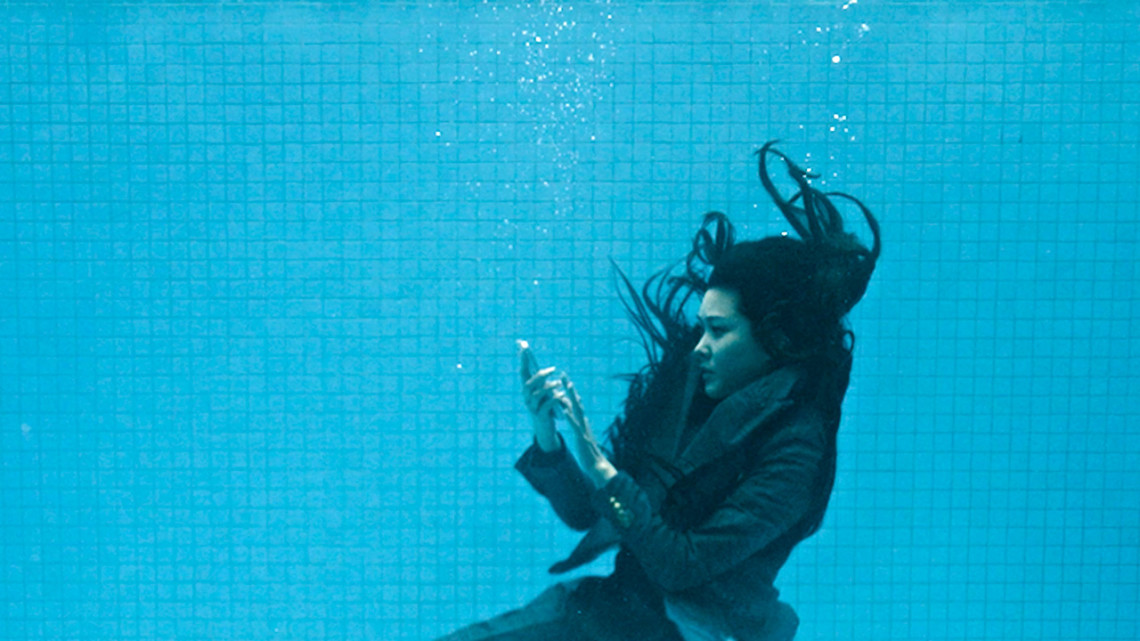
Still from Jen Liu’s “The Land at the Bottom of the Sea.”
Cornell Tech’s Backslash initiative sparks transdisciplinary art
By Grace Stanley
What does it mean to vanish?
It’s the question explored by “The Land at the Bottom of the Sea,” a multimedia installation featured earlier this year as part of the “Monstrous Beauty” exhibition at the Metropolitan Museum of Art in New York City.
Through surreal live-action video, 3D animation and organic sculptures, artist Jen Liu reflects on vanishing – not just physically, but financially, politically and socially. Liu’s work reflects on the collapse of once-trusted systems – labor movements silenced under state pressure, techno-optimism sinking under environmental crisis – and the fragile traces that survive their loss.
The underwater world was realized at Cornell Tech, where, in 2022, the arts initiative Backslash first nurtured the project. Founded in 2016 to connect artists with technologists and academics across Cornell’s campuses, Backslash has grown into a global launchpad, with its artists debuting works at major venues, including the Taipei Biennial, the Contemporary Arts Museum Houston, the Asia Culture Center, the M+ Museum in Hong Kong and Cornell’s own Herbert F. Johnson Museum of Art.
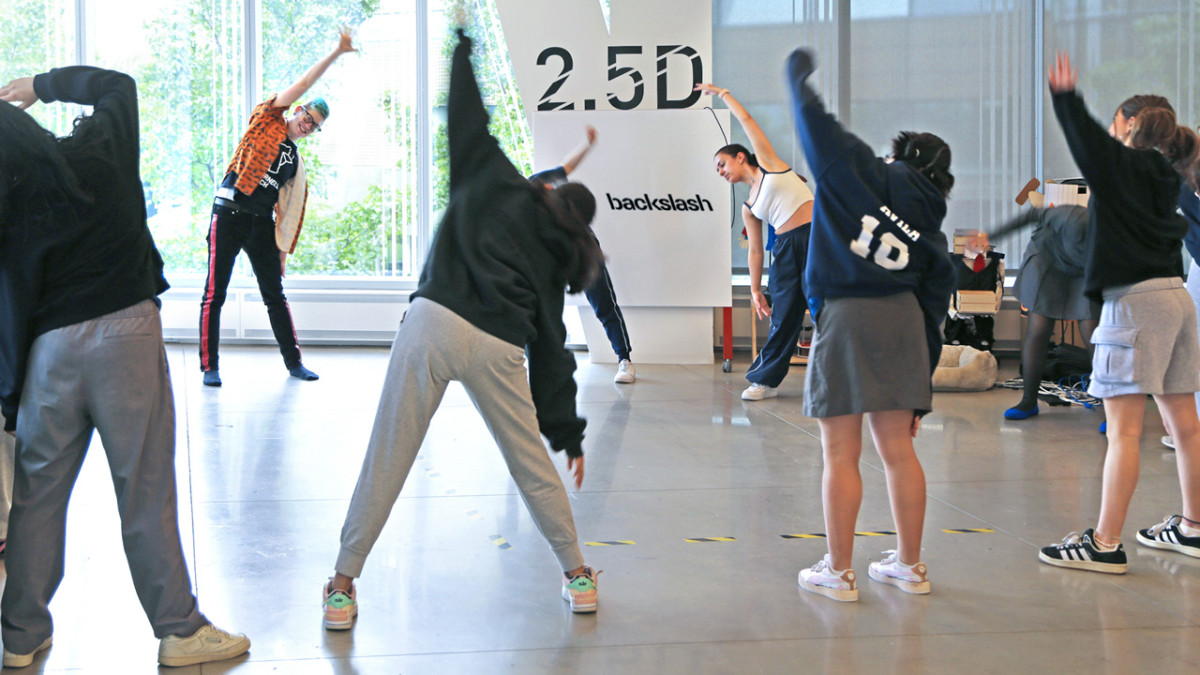
Spence Ray, director of the K-12 Lab at Cornell Tech, leads a movement and coding workshop with students from The Young Women's Leadership School on campus.
At Cornell Tech, Backslash artists collaborate with students and researchers to push both art and technology into unexpected territory. Liu, for example, partnered with information science student Soul Choi, M.S. ’22 to experiment with artificial intelligence. Together, they trained models on activist narratives, factory workers’ social media posts and feminist texts – exploring whether technology could safeguard these stories or, through its own biases and blind spots, risk erasing them.
“The piece was vastly different from its first concept to its final form in truly wonderful ways, largely because Soul could help me through the landscape of quickly changing technology, and we could discuss its implications on a detailed level,” Liu said. “In the end, we were able to use programming in ways that I didn’t know were possible before this process – in ways I think are surprising even now, after the massive explosion of AI applications and think pieces.”
Since its founding, Backslash has granted more than $500,000 to practicing and student artists and engaged more than 200 students and faculty across over 20 departments. This year marks Backslash’s most visible chapter yet: A dedicated studio in the Tata Innovation Center on the Cornell Tech campus now hosts artists, students and faculty working side by side. Five artists are actively creating new pieces with Cornell collaborators.
The arts initiative was launched by Greg Pass ‘97, Cornell Tech’s founding chief entrepreneurial officer when it opened in 2012. Pass – who has been an entrepreneur, Twitter’s first chief technology officer, the chairman of the arts nonprofit Rhizome and a professor of practice at Cornell – said he sought to fund artists whose practices are nonlinear and adventurous – works that, like its namesake, the “\” character in computer programming, escape the “normal mode of input and output to do something special.”
“Fostering an environment where multiple artists and technologists can invent, ideate and produce collaborative work pushes experimental art practices into reality,” said Vinny Kwang Campagna ’22, Backslash’s community manager.
Broadening the scope
The current wave of campus artists includes Noah Feehan, who approaches art with the curiosity of a scientist. “A lot of my stuff sort of takes the form of an experiment with no hypothesis. Working with people who are in the business of formulating research questions and getting answers to them in a repeatable way is really helpful to me,” Feehan said.
Feehan is collaborating with Cornell Tech associate professor Wendy Ju on “SWOON ROUTINE,” a performance featuring quadcopter drones. In a field test, Feehan showed off a small aircraft hovering above sunlit treetops, which then suddenly surrenders to gravity, plummeting toward the earth with a sudden swooshing “swoon,” only to recover at the last possible instant and soar skyward again.
Feehan is pushing drone technology beyond its intended limits, modifying open-source flight-control systems and engineering a reckless “performance mode” in which three drones repeatedly lose control, freefall and recover at the brink of destruction, like in a collective dance.

Backslash artist Noah Feehan working on a field test of his drone performance, “SWOON ROUTINE.”
“It’s been a delight,” Feehan said of working with Ju and her students. “They’ve both broadened the scope of what I believe is possible and helped focus it.”
Ju, an associate professor in the departments of Design Technology and Information Science, noted that the program encourages students to think beyond traditional research paths. “Backslash has been terrific in helping students develop work that has more of a cultural and performance angle,” she said. “The Backslash projects also enable novel collaborations, which can lay the groundwork for more knowledge sharing and a richer sense of community.”
Meanwhile, Backslash fellow and practicing artist Lawrence Abu Hamdan is partnering with Laura Cortés-Rico, a doctoral student in information science, on a spatial sound- mapping project. Backslash artist Backslash artist Tianyi Sun is creating a film exploring the intricacies of data collection, and artist Niko Koppel is developing an immersive mixed-reality installation that captures the unraveling of America. Fellow Mimi Ọnụọha is debuting her Backslash artwork, “Ground Truth,” at The Vienna Secession.
“Backslash provided me with support and the ability to expand my world and understanding by interacting with faculty and students whose work was completely different from mine,” Ọnụọha said. “I found the experience inspiring. It was definitely essential to the creation of my latest work.”
Cornell art history doctoral student Rodrigo Guzman Serrano was recently named the inaugural Backslash Scholar, receiving an award to research and critically write about the cultural intersections of art and technology.
In addition, Backslash awards microgrants to students pursuing transdisciplinary projects both within and outside of the classroom.
“The guidance and resources of Backslash have contributed to the energization of collaborations of art and technology across Cornell’s campuses,” said Timothy Murray, professor emeritus and former director of Cornell Council for the Arts, who was an early supporter of the Backslash initiative. “The microgrants provided to Ithaca undergraduates have led to exciting, cross-disciplinary projects linking computing, design, art, performance and architecture, with additional applications in sustainability, ornithology and biology.”
Beyond the Cornell ecosystem
Backslash recently secured its first institutional partnerships. Hosted by Backslash on the Cornell Tech campus, Rhizome’s 7x7 program paired artists with legal scholars to co-create projects that reimagine laws shaping technology – addressing issues like AI regulation, copyright for digital art and online identity. Backslash also collaborated with Ballet Hispánico and Cornell Tech’s K-12 Initiative, through the Doris Duke Foundation’s Performing Arts Technologies Lab, to rethink how dance and technology can intersect in education.
“Receiving support from Doris Duke marked an exciting milestone for Backslash. It signals how our propulsive mission, centering artistic practice as a driver of technological innovation and research, has significance beyond the Cornell ecosystem,” said Michael Byrne, the creative lead for tech, arts and culture at Cornell Tech.
These collaborations, performances and partnerships reflect the vision that sparked Backslash nearly a decade ago. “People are often surprised by the sheer amount of art happening at Cornell Tech, but we are not a conventional technology campus,” Pass said. “Backslash escapes convention.”
Grace Stanley is the staff writer-editor for Cornell Tech.
Media Contact
Get Cornell news delivered right to your inbox.
Subscribe