Seamless tech: ‘OriStitch’ threads computation and 3D textiles
Seamless tech: ‘OriStitch’ threads computation and 3D textiles
By Louis DiPietro
Could a flat piece of fabric hold a 3D shape, the way paper does in origami?
Aiming to find out, researchers from the Cornell Ann S. Bowers College of Computing and Information Science developed OriStitch, a new software and fabrication system that takes simple 3D objects – a toy or a teapot, say – and spins them into a design for a textile version using carefully placed stitches in fabric.
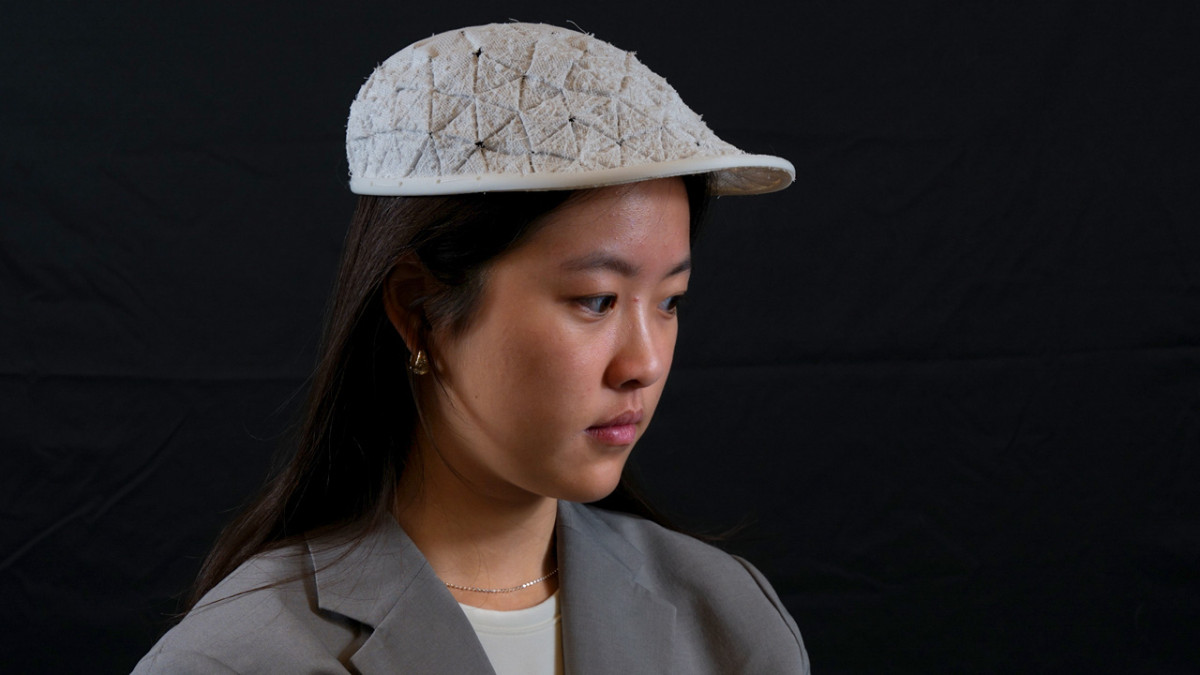
Xinyue Hu, a master's student at Cornell Tech, models a hat created with OriStitch, a new software and fabrication system developed by Cornell Tech researchers.
This approach is more efficient and accessible than existing machine embroidery – and could be a creative boon for areas such as fashion, architecture and smart textiles, according to researchers.
“Folding fabric into 3D geometries is time-consuming,” said Thijs Roumen, assistant professor of information science at Cornell Tech and senior author of “OriStitch: A Machine Embroidery Workflow to Turn Existing Fabrics into Self-Folding 3D Textiles,” which was presented at the ACM Symposium on Computational Fabrication on Nov. 21 in Cambridge, Massachusetts. “Current approaches either rely on manual processes – like in hand-pleating – which is labor-intensive, or advanced machine-based processes.”
But designs made with OriStitch fold themselves when exposed to heat, he said.
“OriStitch can be used with a wide range of materials, like leather, felt, woven fabric, and composite fabrics,” said Zekun Chang, doctoral student in the field of information science at Cornell Tech and the paper’s lead author. “By making textile folding easier, we hope to unlock its broader potential – enabling personalized 3D forms shaped from flat patterns, and making it possible to embed smart functions like sensing before the fabric transforms into 3D.”
OriStitch’s core innovation lies in its design of fully closed hinges, each formed by a pair of triangles that are pulled closed when the heat-shrinking polyester thread, called chizimi, contracts. First, OriStitch converts a user input 3D triangle-mesh model into a 2D configuration, producing a network of hinges. Then the tool computes the functional patterns for each hinge’s geometries, generating a fabrication-ready plan for both laser cutting and embroidery.
Users can then fabricate the design: The laser cutter scores the mountain and valley folds to create sharp creases and trims away the excess fabric. An embroidery machine stitches all functional threads – including the heat-shrink thread – according to the generated layout. After embroidery, the piece is soaked in water to dissolve the water-soluble support stitches, and finally heat-treated, causing the chizimi threads to contract and pull all hinges closed, forming the target 3D shape.
In tests, the software successfully converted 26 out of 28 test models used in related papers in the field of computational fabrication. Researchers also successfully fabricated a cap, vase cover and handbag using OriStitch.
“What is really interesting about OriStitch is that it is compatible with existing hardware and fabrics, rather than weaving or knitting new fabrics from scratch,” said Roumen, who directs the Matter of Tech lab at Cornell Tech. “That practicality and utility should sync nicely with existing workflows in industry.”
OriStitch is still far from being a fully automated process, since embroidery machines require manual adjustments, researchers said. Looking ahead, Chang hopes to extend the approach beyond uniform textiles and develop machine workflows for a much broader range of materials – especially those with diverse structural variations, such as seams that are difficult for other fabrication methods to handle.
Along with Chang and Roumen, the paper’s authors are: Yixuan Gao, doctoral student in the field of computer science at Cornell Tech; Yuta Noma from the University of Toronto, Canada; Shuo Feng, doctoral student in the field of information science at Cornell Tech; Xinyi Yang of Georgia Institute of Technology; Kazuhiro Shinoda, Tung Ta, Koji Yatani, Tomoyuki Yokota, Takao Someya, Tomohiro Tachi, Yoshihiro Kawahara, and Koya Narumi, all of the University of Tokyo; and François Guimbretière, professor of information science.
This work was partially supported by JST Adopting Sustainable Partnerships for Innovative Research Ecosystem (ASPIRE).
Louis DiPietro is a writer for the Cornell Ann S. Bowers College of Computing and Information Science.
Media Contact
Get Cornell news delivered right to your inbox.
Subscribe