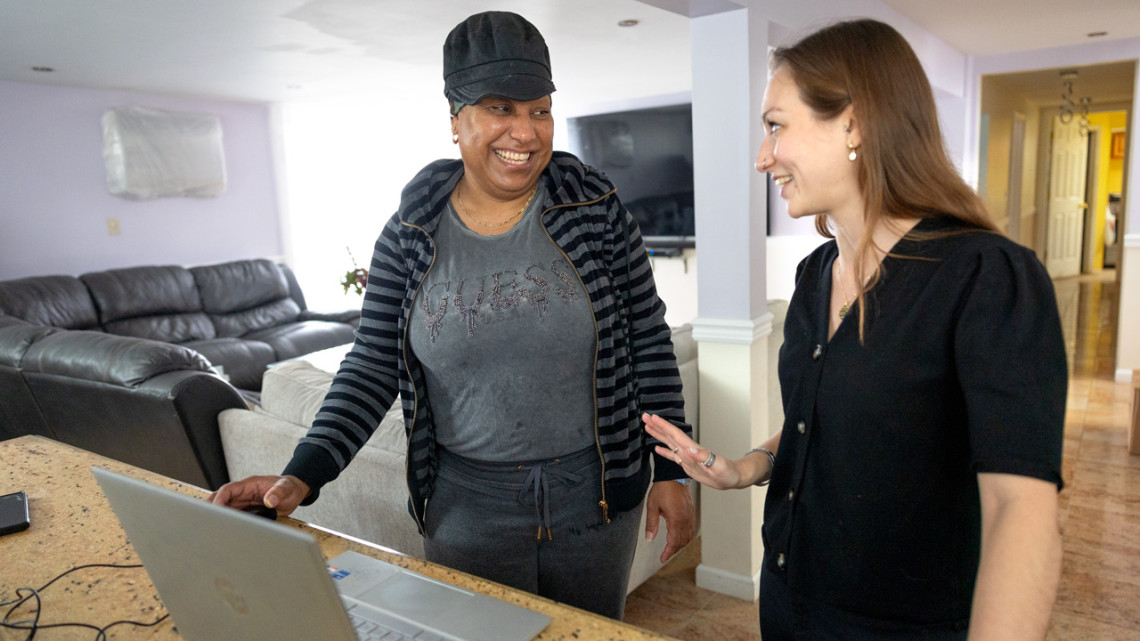
Long Island resident Suzette Foote (left) talks with Shannon Fabiani, energy adviser with the Long Island Regional Clean Energy Hub, about clean energy upgrades for Foote’s home.
CCE helps Long Island residents save on energy bills
By Susan Kelley, Cornell Chronicle
Suzette Foote’s Long Island house was so poorly insulated last winter that she had to turn her thermostat up to between 80 and 90 degrees – and her house was still chilly.
“I was losing heat, and the cold air was coming in from the attic,” she said.
And her energy bills? “Very high – too high,” said Foote, a single mother who has lived in her North Woodmere home for 18 years.
So in July 2025, Foote sought help from the Long Island Regional Clean Energy Hub, run by Cornell Cooperative Extension (CCE) Nassau County. The free program helps Long Island residents and businesses reduce their energy use, transition to clean energy sources and lower their heating and electric bills.

Shannon Fabiani, energy adviser with the Long Island Regional Clean Energy Hub, inspects air handlers at the home of Suzette Foote in Long Island.
The program is part of New York state’s Climate Leadership and Community Protection Act. Signed in 2019, it is one of the nation’s most aggressive climate laws, requiring a 40% reduction in greenhouse gas emissions by 2030 and 85% by 2050 from 1990 levels. It mandates 70% renewable energy by 2030, 100% zero-emission electricity by 2040. It directs 60% of benefits to most New Yorkers and 40% to disadvantaged communities.
Participants get one-on-one advising and up to $40,000 in subsidies for weatherization, heat pumps, solar and more. In 2025, the hub facilitated $785,000 in clean energy subsidies for residents of Nassau and Suffolk counties and the Rockaways.
“There are a lot of options for how someone can improve their energy use. A lot of the time, they don’t know where to start, so we’re there to help them,” said Shannon Fabiani, a CCE energy adviser who worked with Foote.
Three months after Foote reached out to the hub, she had discounts totaling $115 off her monthly utility bills and had received more than $20,000 in subsidies to insulate her attic, weatherize her house and install central air conditioning and two air source heat pumps.
“Now I leave the thermostat at 67 and the house is still warm,” Foote said.
In the summer, the new central air system keeps her house comfortably cool. Before the improvements, the temperature in Foote’s house rose so high it triggered her 16-year-old daughter’s chronic disease, supraventricular tachycardia, which makes her heart beat abnormally fast in high temperatures and humidity. “With the heat, her heart would race away,” Foote said.
Now the house remains cool in the summer. “It made a difference here,” Foote said. “It’s the best thing on earth.”
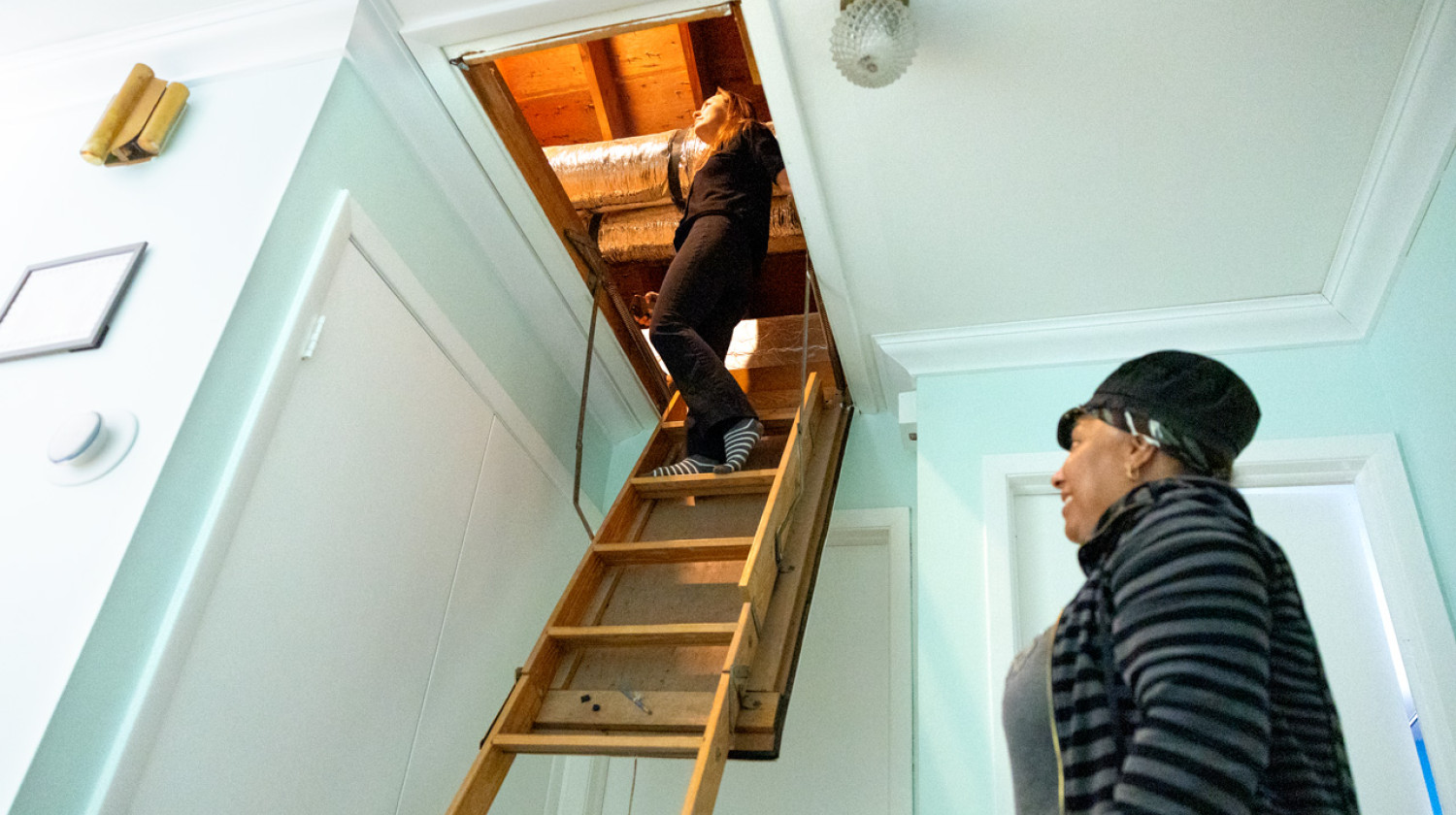
Suzette Foote (right) watches Shannon Fabiani, energy adviser with the Long Island Regional Clean Energy Hub, inspect new upgraded insulation in Foote’s home.
Efficient energy for everyone
The Long Island hub is one of 12 regional clean energy hubs around the state, designed and supported by the New York State Energy Research and Development Authority (NYSERDA). CCE also lead hubs in Dutchess, Oneida and Tompkins counties.
Hubs help residents and businesses understand their energy use and find ways to lower their bills. And they offer workforce training in the clean energy industry. In 2025, the Long Island hub created a comprehensive resource directory itemizing all technical vocational training programs on Long Island.
But the main focus is making clean energy accessible to everyone, said Mike Fiorentino, natural resource program team leader at CCE Nassau. Foote was one of 638 Long Island residents whom the Clean Energy Hub served in 2025. “We answer questions from anyone,” Fiorentino said, “but our outreach is primarily targeted toward low- and moderate-income residents.”

Fabiani discusses work with her colleagues at the Cornell Cooperative Extension Nassau County office in East Meadow, New York. From left to right: Fabiani; Jaiden Fox, communications and event coordinator; Faith Laudano, associate hub director; and Chad Marvin, clean energy workforce development manager.
The Climate Leadership and Community Protection Act requires at least 35% of funding at every hub goes to people at lower socioeconomic levels; they are most disproportionately affected by climate change and rising utility rates. But the Long Island hub far exceeds that requirement, Fiorentino said. “We have a goal of engaging with all 92 disadvantaged community census tracts on Long Island and are well on our way to accomplishing that goal.”
They engage that demographic with outreach, from job fairs to tabling at local libraries and food pantries. In 2025, Long Island hub staff attended more than 400 clean energy outreach events.
For example, energy advisers run workshops where participants learn simple actions that could immediately cut energy costs. They leave with a DIY energy literacy kit, worth $45, including supplies like LED lightbulbs and weather stripping for drafty windows.
The hub also hires well-connected residents in disadvantaged neighborhoods as independent outreach consultants called community navigators, Fiorentino said. “They’re excellent ambassadors, because they already have those relationships within the communities,” he said. “They’re going to their community centers, they’re going to the libraries, their houses of worship and they’re acting as positive, credible messengers for the work that we do.”
Keeping projects on track
Before Foote got involved with the hub, she first contacted NYSERDA for energy help. There she got a free energy assessment that found her attic had only 2 inches of deteriorating fiberglass insulation. And it showed Foote’s natural gas heating system had a “worst case” rating in health and safety tests that ensure fuel-burning appliances safely vent exhaust, especially carbon monoxide.
Foote received funding to improve the insulation, but the contractor she hired often failed to show up.
So she turned to the Long Island hub for help. Fabiani helped Foote find a more reliable contractor. “A lot of our work is managing relationships with contractors and residents so that projects can stay on track,” Fabiani said.
And Fabiani helped Foote navigate the often confusing thicket of low- and no-cost energy assistance programs funded by utilities and by the state.
With Fabiani’s support, Foote got subsidies from the New York State Empower+ program to upgrade her attic insulation with 12 inches of cellulose and targeted air sealing to fill gaps. The project also improved the house’s indoor air quality, with a vapor barrier in the attic crawl space, ventilation from soffit vents, a new bathroom fan and carbon monoxide and smoke detectors. She also got weatherization measures like new door-sweeps and energy-saving power strips. In all, the programs paid $9,140 for the project, at no cost to Foote.
Then Fabiani helped Foote address her inefficient natural gas heating system.
Confusion about a subsidy program run by her utility, PSEG Long Island, nearly prevented Foote from applying. She was ready to give up – but Fabiani explained the program’s rules and how to apply.
Much of Fabiani’s work is keeping track of the subsidy programs’ ever-changing rules and regulations, and guiding residents through the application process. That requires building trust with residents, Fabiani said.
CCE Nassau’s well-established community ties from its other programming, from nutrition to youth and family services, make it easier to establish strong relationships with residents, Fabiani said. “That credibility and trust in the extension name carries has carried a lot of weight for me in conversations I’ve had with folks.”
After PSEG Long Island approved funding, Fabiani helped Foote identify a contractor who could install two new air source heat pumps. When Foote misunderstood the technical details of contractor’s estimate and rejected the proposal – she wanted just one unit, not two – Fabiani talked with her about how heat moves through the home so she could understand why her home actually needed two air pumps to meet efficiency requirements.
“There were times Suzette mentioned wanting to give up on the project because of all the hurdles, or contractors being unresponsive,” Fabiani said, “but small interactions from energy advisers as a third party can help residents stay in the program.”
In the end, Foote chipped in $3,000 toward the two heat pumps, while PSEG Long Island provided an $11,000 subsidy.
Together, these measures will help Foote reduce her energy costs over time. The weatherization measures in her attic alone will save her nearly $14,000 in lifetime savings, Fabiani said. In the meantime, Fabiani also helped Foote sign up for discounts on her electric, gas and water bills totaling $1,400 per year.
Fabiani has been a great help throughout the process, Foote said. “Couldn’t have been better,” she said. “She was easy to talk to, and I see results with her.”
Foote told a friend about the hub program and introduced her to Fabiani, who recently took on the new case.
“I’ve been working with her to try to access some of the programs too,” Fabiani said.
Media Contact
Get Cornell news delivered right to your inbox.
Subscribe