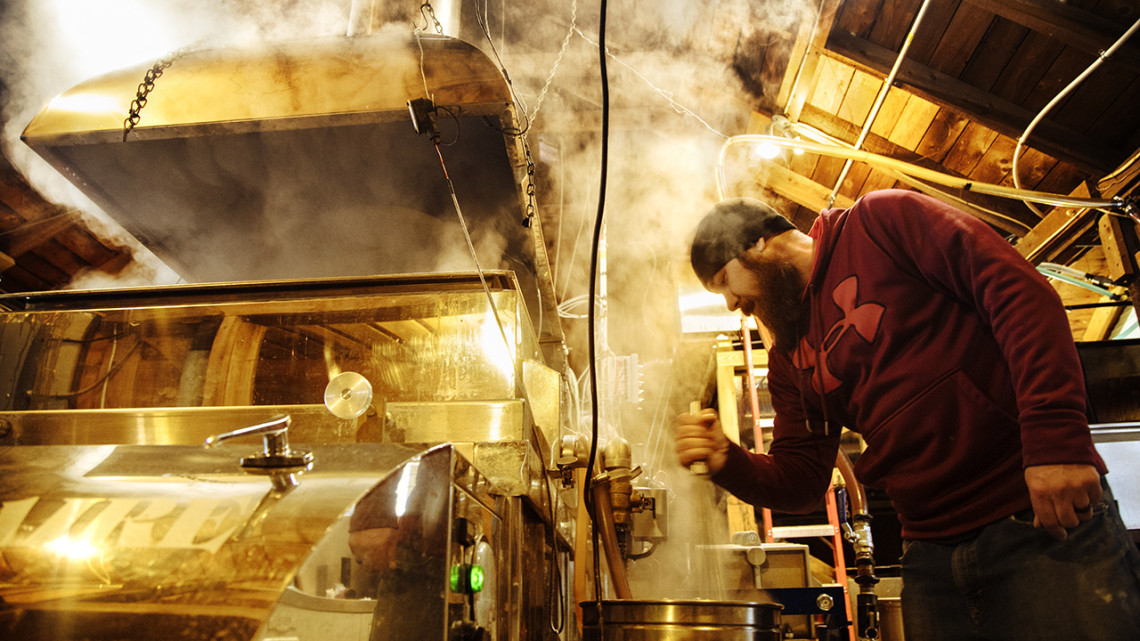
Maple sap is boiled down at Cornell’s Arnot Teaching and Research Forest in Van Etten, New York.
Sap chiller to improve quality of life for maple producers
By Caitlin Hayes, Cornell Chronicle
On a 65-degree day during last year’s maple season, Chad Virkler and his family boiled all night to keep up with the flow of sap – if they let it sit, it would spoil.
“Ropey syrup is not a myth, you can actually make it if you let your concentrate sit around at that kind of temperature,” said Virkler, owner of Virkler Farm and Forest in Danby, Vermont.
This season, a new low-cost, do-it-yourself method from the Cornell Maple Program could prevent all-nighters. The approach, particularly useful as winters grow warmer and more variable, allows producers to cool and hold sap before boiling, giving them greater flexibility in their schedules and improving processing efficiency – especially helpful for smaller-scale operations.
“If we can keep our concentrate cold, we can come back to it in the morning,” Virkler said. “We’re hoping Cornell’s input will provide the Virkler family with more sleep. That’s the goal.”

The low-cost, do-it-yourself sap chiller pumps cold glycol through a chilling plate in a small tank.
Inspired by home-brewing methods, the system uses glycol to chill the sap and reduce the microbial activity that spoils it. A simple setup requires only an air conditioner unit, a picnic cooler and a heat exchanger – all totaling less than $1,000.
“Within the industry, costs of equipment have increasingly gone up in recent years, whereas the price of syrup really hasn’t,” said Adam Wild, co-director of the Cornell Maple Program and the Henry and Mildred Uihlein Director of the Uihlein Maple Research Forest in Lake Placid, New York. “It’s been my mission to see how we can help develop methods that improve efficiency and help producers with the quality of their syrup without breaking the bank.”
Wild has published two extension bulletins about the benefits of chilling sap with glycol and how to build a sap chiller.
David Campbell, co-owner of Mapleland Farms in Salem, New York, said being able to chill the sap will improve efficiency on his farm, allowing him to store smaller runs of sap and consolidate boils. That would reduce setup, cleanup and the energy used to get the sap up to a boil. In trials at the Uihlein Forest in 2025, Wild found that the sap chiller reduced the number of boils by 40% and saved 24 hours of labor.
“That increases profitability and lowers time in the sugar house,” said Campbell, who, with Wild’s help, won a grant from the New York Farm Bureau to build a sap chiller this season. “Then you can spend more time in the woods and do a better job keeping your vacuum up.”
The setup’s air conditioner cools a glycol solution, held in a picnic cooler, which is then pumped through the coils of a heat exchanger. The sap is filtered through the exchanger, and the coils cool the sap to a safer temperature for storage. The approach can be used in different setups: by running the chilled glycol through copper tubes around the outside of a sap storage tank, for example, or through the coils of a chilling plate inside the tank.
Other options for chilling sap come with high costs. New commercial refrigerated tanks can cost up to $80,000, plus delivery and installation fees. Wild said maple producers often buy used tanks and compressors from dairy farms, but the systems require inspection and installation by a specialist and frequently use refrigerants that are no longer manufactured.
“The reason we went to the homemade solution is that it’s been impossible for me to find a technician who can even hook up the other system,” Virkler said. “It turns out I can do a lot with a $1,500 or $2,000 bulk tank by adding $1,000 of homemade materials.”
Wild said the sap chiller has attracted a lot of interest from producers in New York state and beyond. And while variations of the method can be useful for operations of any size, it might be particularly helpful for smaller operations where producers work other jobs, he said.
“They can chill down the sap and not worry about it spoiling while they’re at work, and they can save up a few days’ worth of sap and boil on the weekend,” he said. “It helps with that quality-of-life balance, where you don’t need to be at the mercy of when the sap is flowing.”
Wild’s work on the sap chiller follows decades of research at the Cornell Maple Program – at Uihlein Forest and the Arnot Teaching and Research Forest in Van Etten, New York – to help maple producers improve efficiency and productivity. Researchers have provided guidance on taphole size, the potential of re-tapping trees at different times during the season, best practices for vacuuming sap from trees, and taphole and tubing sanitation protocols – all of which have vastly increased production.
“There are very few universities in the country doing maple research, and it’s definitely needed, even more so now with the climate the way it is,” Campbell said. “The amount of research done over the years has helped dramatically improve the production of maple syrup, starting back at vacuum being added to the sap collection system, which doubled the production.”
One of Campbell’s main uses for the sap chiller will be to chill and hold sap for demonstrations at three open-house weekends they run annually, each drawing 500 people.
“We do a pancake breakfast and like to demonstrate the process,” he said. “People like to see the steam rising off the pans and the smell of it.”
Virkler agreed that maple syrup draws people together. “Maple has built a family and community as well as a business,” he said, “and I appreciate what the research institutions are doing to keep giving direction to the industry.”
Funding for the sap chiller project came from the Northern New York Agriculture Development Program.
Media Contact
Get Cornell news delivered right to your inbox.
Subscribe