CCE helps NYS gardeners test their soil for nutrients, contaminants
By Susan Kelley, Cornell Chronicle
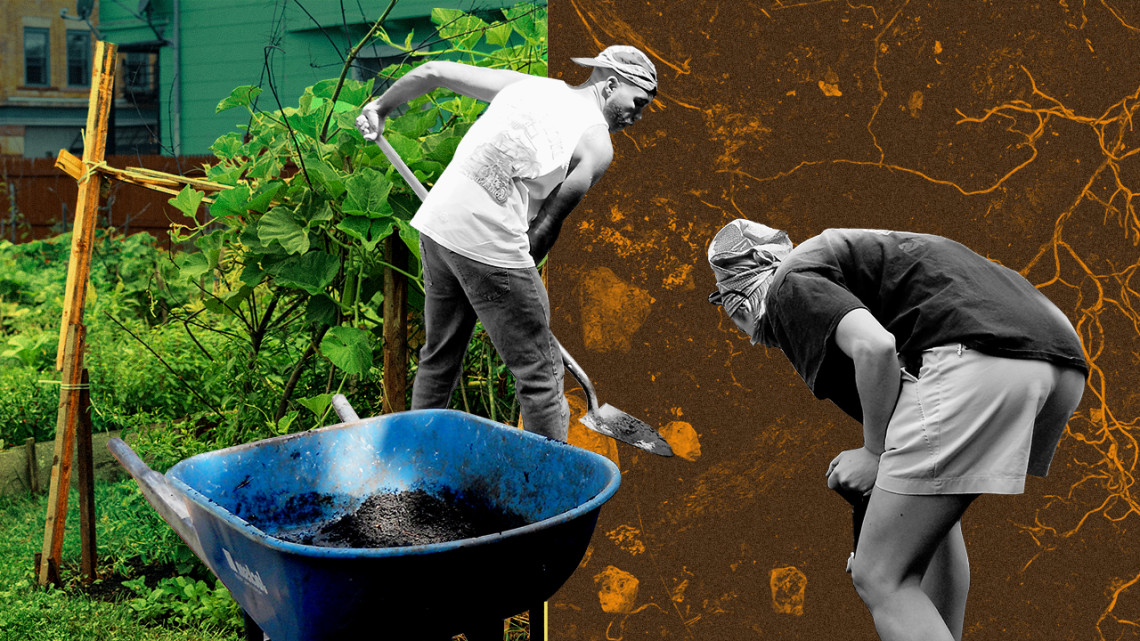
Last fall, Shannon Fitzpatrick watched construction dust and debris blow from the upper floors of an abandoned building renovation next door. The dust was landing on the beds of her Brooklyn neighborhood’s community garden.
“It made me feel just suspicious of what was ending up in the soil and how it was affecting the food,” said Fitzpatrick, who has gardened there for two years. “Those older buildings, they do have asbestos and lead – you just never know.”
So this spring she and her fellow gardeners at the 462 Halsey Community Farm in Bedford-Stuyvesant applied for and received 22 free soil tests from the Community Gardens Soil Testing Program. Cornell Cooperative Extension (CCE) Harvest New York offers the program to home and community gardeners anywhere in the state, in partnership with New York state’s Department of Agriculture and Markets and the Cornell Soil Health Laboratory.
The tests analyze soil for heavy metals and nutrient levels. The results help gardeners make plans to amend their gardens, and CCE Harvest New York staff can advise gardeners with technical support and education on how take the right next steps.
Anyone is welcome to harvest the produce grown at the 462 Halsey Community Farm, including children, Fitzpatrick said. “We just want to do right by them and make sure that they’re getting the healthiest food they can from the garden.”
Ag and Markets provides funding for soil tests, which are conducted by the Cornell Soil Health Laboratory, part of the College of Agriculture and Life Sciences. The tests are available for free to noncommercial gardeners who grow food for themselves or share it with friends and neighbors. CCE’s Harvest New York urban garden team coordinates the program, now in its third year. In 2025, the program distributed over 400 tests statewide.
The tests are available on a first-come, first served basis until supplies run out. Home gardeners fill out an application, receive a confirmation number and a prepaid shipping box, then fill a plastic bag with about two cups of their soil. CCE staff may be available to assist, depending on the gardener’s location. Then the gardener mails the soil sample to the lab. Within six to eight weeks, the gardeners receive their results. CCE regional specialists follow up with advice on how to interpret the test’s findings.
“It really gives a comprehensive look at the soil. It’s a unique feature of this program, which can really lend to those reliable results,” said Mallory Hohl, the program coordinator and an urban garden specialist with Harvest New York.
The tests analyze not only heavy metals but also a comprehensive spectrum of elements, as well as organic matter and pH, which are critical indicators for soil health, said Kwesi Joseph, urban garden specialist for CCE Harvest New York. “You get to know if you’re lacking in any of the macro or micronutrients that are essential for plant health.”
Because community gardens in New York City are typically 100% compost, a common soil problem is an excess of the macronutrients, like nitrogen, phosphorus and potassium, Joseph said. “That may slow the absorption of the other of the micronutrients.”
He’s been teaching gardeners to amend their soil with rock dust, which is crushed basalt. “When you see images of lava flowing out of a volcano, 70% of that stuff is basalt. It’s dark, dense rock, and it’s very high in trace elements,” Joseph said. “If you add that to the soil, the life in the soil will slowly interact with that rock and make those elements biologically available for the plants to use.”
Many urban gardeners use compost because they’re able to access it cheaply and easily. “It’s not as simple as saying, ‘Well, just don’t use it.’ That’s not always an option,” Joseph said. “We have to think through those solutions on how to help them, knowing what they’re growing in.”
Joseph worked with Fitzpatrick to distribute the 22 soil tests to the gardeners at the 462 Halsey Community Farm and send them to the Soil Testing Lab. This year they’ve decided to grow only nonedible plants, including sunflowers, butterfly weed, bachelor buttons, dahlias, luffa sponges, gourds and sorghum, and focus on remediating the soil. “Our gut instinct, collectively, is that the soil needs some love,” she said. “I’m interested in the soil and the planting, but I don’t always know the science behind it, so it’s interesting to learn a little bit more about that.”
If the tests show that heavy metals are present in the soil, the most important thing for people to do is to wash their fruits and vegetables, Joseph said. “There’s a lot of media hype about heavy metals in community gardens. That was making it seem like the plants were toxic.” In fact, the heavy metals in the soil splash onto the leaves and plants, rather than being absorbed by them, he said.
“Since we’re offering individual technical assistance based on their results report, we’re able to offer that gem of insight that maybe isn’t common knowledge. We are able to work one-on-one with that grower,” Hohl said.
The program provides a structured, guided process for people who may be intimidated by the steps to do a soil test, and who may not have the money to do it, Joseph said.
“It’s a great resource that’s provided to gardens,” Fitzpatrick said. “It feels empowering to know what’s in our soil, what’s getting into our food and to make sure that it’s as healthy as it can be – and if not, that we can take steps to ameliorate it.”
To learn more, contact program coordinator Mallory Hohl at mdh286@cornell.edu.
Media Contact
Get Cornell news delivered right to your inbox.
Subscribe