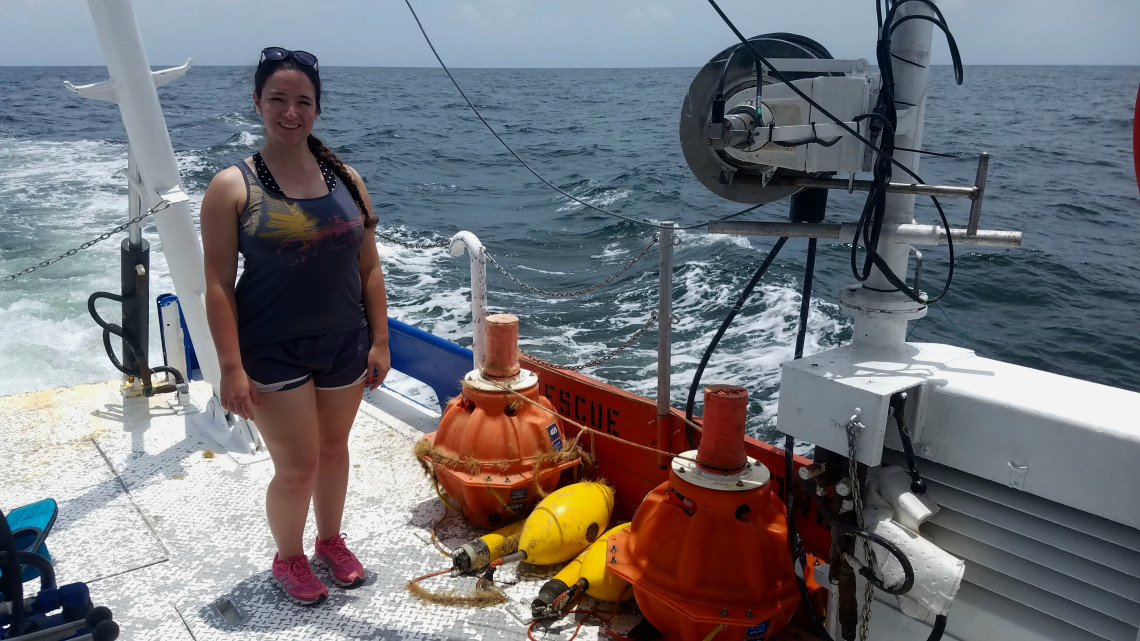
Dawn Parry, a Ph.D. graduate in natural resources and the environment at Cornell, helps recover acoustic recording devices used to monitor whales and ocean noise in the Gulf of Mexico as part of her graduate research.
News directly from Cornell's colleges and centers
Sea Grant seeks graduate students for 2027 Marine Policy Fellowship Program in D.C.
By Paul Focazio
New York Sea Grant (NYSG) is looking for graduate students to apply for Sea Grant’s John A. Knauss Marine Policy Fellowship (Knauss Fellowship), a nationwide program that provides year-long unique opportunities to work in Washington, D.C. executive (federal agency) and legislative (U.S. House of Representatives and Senate) offices where they contribute to real-world marine policy work.
Students interested in ocean, coastal and Great Lakes resources are encouraged to apply via NYSG by June 3rd for 2027 fellowships, where they will bring science, innovation and fresh perspectives to decision-making and leave with practical skills and a national professional network.
Around the time of the 2027 fellowship’s deadline, Anna Mehlhorn, a Ph.D. candidate in Natural Resources and the Environment at Cornell, will begin her 2026 Knauss Fellowship in the Office of Science and Technology at NOAA Fisheries, where she will serve as its Recreational Fisheries Partnership Program Coordination and Science Communications Fellow. Mehlhorn, and two others from New York — Brianna Lounsbury (SUNY ESF) and Kate Blackwell (SUNY Stony Brook) — join 45 other finalists from across the nation in D.C. for 2026’s 47th class of the Knauss Fellowship.
Mehlhorn has accumulated a wealth of experience in aquatic ecology and environmental education. For several years, she worked in coastal communities as a research assistant and field educator, using creative tools to communicate environmental messages and strengthen place-based connections. In these roles, she has also witnessed environmental challenges firsthand, like invasive species and sea-level rise.
Mehlhorn sees the fellowship as an opportunity to take a multifaceted approach to federal policy, especially as it relates to her interests in estuarine ecosystems, field education, and deep-sea mining.
“I have always enjoyed bringing people with different ways of viewing the world into conversation, especially as someone working at the intersection of art and science,” said Mehlhorn. “As a Knauss Fellow, I hope to build on this interest by connecting [with] scientists, legislators, organizations, and others at the forefront of marine conservation.”
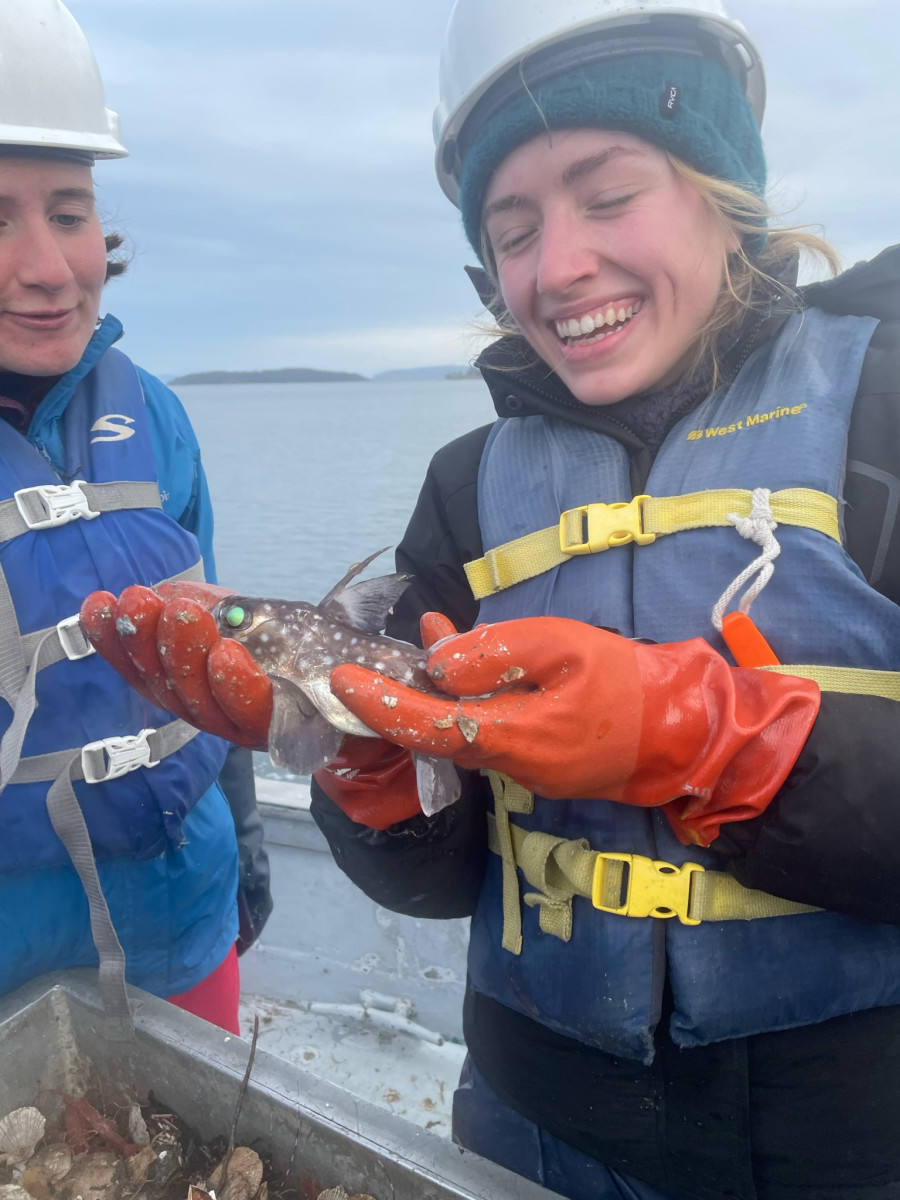
Anna Mehlhorn, a Cornell PhD candidate and incoming Knauss Fellow, collecting deep-sea spotted ratfish (Hydrolagus colliei) off the coast of San Juan Island, Washington, for a fish swimming kinematics project.
Late this past January, Dawn Parry, a Ph.D. graduate in Natural Resources and the Environment, completed her 2025 Knauss Fellowship in the U.S. Department of Energy’s Wind Energy Technologies Office.
Parry, whose PhD work encompassed bioacoustics, ecology, and policy with a prioritization of science communication and public outreach, believes it is essential for scientists to consistently collect routine data in order to address biodiversity loss.
One of Parry’s dissertation projects involved determining how much noise human activities add to the underwater environment of the Gulf Coast, data that can be used to assess human impacts on marine life. She also participated in a Bermuda-based project to provide seasonal occurrence data for whales and economically important fish, and shared acoustic data from the project with undergraduate mentees, who analyzed for toothed whale presence.
Prior to her PhD, Parry worked on a Sea Grant effort to determine which estuaries contribute most to the New Jersey striped bass population.
Above all else, Parry says, it’s important to communicate science to the public.
“I hope to leverage the best available science along with public education and outreach to create informed policy,” Parry said. “My overall goal is to benefit the marine environment, coastal communities, and the economy.”
For more on NYSG’s Knauss fellows, read NYSG’s 2025 fellows story and 2026 fellows announcement.
Since 1971, New York Sea Grant, a cooperative program of Cornell University and the State University of New York, has been one of 34 university-based programs under NOAA’s National Sea Grant College Program. The extension portion of NYSG’s programming is administered through Cornell Cooperative Extension.
Media Contact
Get Cornell news delivered right to your inbox.
Subscribe