NASA’s Dragonfly mission, which will send a rotorcraft relocatable lander to Titan’s surface in the mid-2030s, will be the first mission to explore the surface of Titan.
Lessons from suicide survivors – people who, despite the urge to die, find ways to cope and reasons to live – are seldom heard, but Cornell researchers and their colleagues have written one of the first studies to change that.
Saul Teukolsky, the Hans A. Bethe Professor of Physics and Astrophysics in the College of Arts and Sciences, has been awarded the International Centre for Theoretical Physics’ 2021 ICTP Dirac Medal and Prize for his contributions to the detection of gravitational waves.
Researchers trust international and scientific groups the most, and militaries, Chinese tech companies and Facebook the least, to shape the development and use of AI in the public interest.
The Royal Liverpool Philharmonic Orchestra will launch its 2021-22 season on Oct. 14 with the world premiere of “Symphony No. 6,” composed by Roberto Sierra, the Old Dominion Foundation Professor in the Humanities in the College of Arts and Sciences.
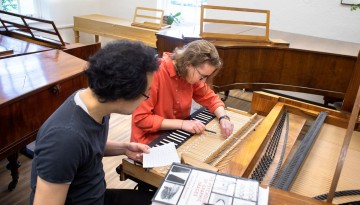
An undergraduate, Elizaveta Zabelina ’24, is teaming up with a music department faculty member to create an illustrated catalog and guide to the instruments that are part of Cornell's historical keyboard collection.
In a new book, “Policymaker’s Journal,” Kaushik Basu offers musings about economic policymaking and public life during his years serving as chief economic adviser in India’s finance ministry and chief economist at the World Bank.
An international group of scientists now say that reflections of the Mars’ south pole may be smectite, a form of hydrated clay, buried about a mile below the surface.