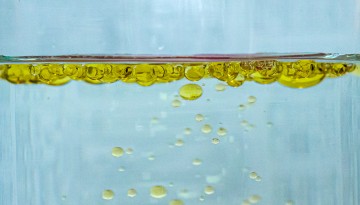
A Cornell team used a new form of high-resolution optical imaging to better understand how adsorption – i.e., the clinging of molecules to surfaces – works on the semiconductor titanium dioxide with a gold particle added as a co-catalyst.
“Colonial Crossings: Art, Identity, and Belief in the Spanish Americas,” opening July 20 at the Johnson Museum, brings a nuanced view to a complicated period in Latin American art, and it is doing so with the help of student curators.
The field of game studies is growing at Cornell, including an expanded set of classes, workshops and symposia and a growing library collection of games.
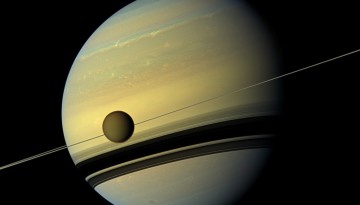
Using data from precision radar experiments, a Cornell-led research team was able, for the first time, to separately analyze and estimate the composition and roughness of sea surfaces on the Saturn moon Titan.
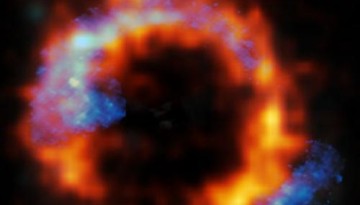
An international research team discovered that the gas in a Hyper Luminous Infrared Galaxy was rotating in an organized fashion, rather than in the chaotic way expected after a galactic collision –– a surprising result.
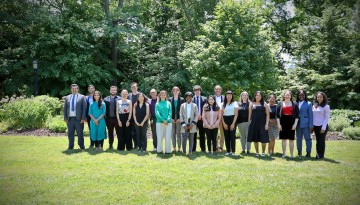
The summer 2024 Colman Inclusive Leadership Program helped 33 doctoral students enhance their leadership skills through readings, interactive group activities, case studies and discussion through the three-day immersive experience.
Abruña was selected in the “non-traditional energy” category for “foundational contributions spanning electrochemistry, batteries, fuel cells and molecular electronics.”