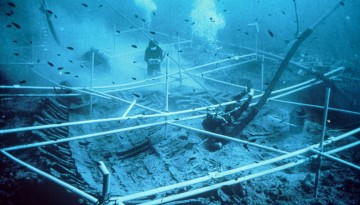
The Cornell Tree-Ring Laboratory identified the likeliest timeline of the Hellenistic-era ship's sinking as between 296-271 BCE, with a strong probability it occurred between 286-272 BCE.
Doctoral student Jonah Botvinick-Greenhouse could be crowned the world’s best juggler in a June 30 competition that aims to help build a case for juggling as an Olympic sport.
Researchers have found that when it comes to politics, Black and Latino residents of rural America differ far less, if at all, from their urban counterparts than do non-Hispanic white residents.
The new Simons Observatory in Chile’s Atacama Desert may soon answer the great scientific question of what happened in the tiny fraction of a second after the Big Bang.
A Cornell-led team used ultrafast laser spectroscopy to scrutinize a key intermediate state during singlet fission and found that in certain molecules the intermediate can be directly generated with a strikingly simple technique.
In 1829, abolitionist David Walker’s “Appeal to the Colored People of the World” went viral, enabling enslaved people to imagine freedom and why they deserved it.
The Amit Bhatia ’01 Global Ph.D. Research Scholars program is supporting doctoral students in completing extended, in-country international research essential for the completion of their dissertations.
The relationship between mother and child offers clues to the mystery of why humans live longer lives than expected for their size – and sheds new light on what it means to be human.
Enzo Traverso, the Susan and Bart Winokur Professor in the Humanities, has received an honorary doctorate from the Universitat Autonoma de Barcelona (UAB).