The Deanne Gebell Gitner ’66 and Family Annual Prize for Teaching Assistants puts graduate TAs in the spotlight, celebrating and recognizing them for their impact and contributions to education at Cornell.
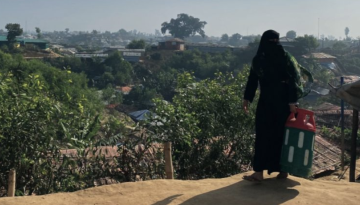
Scholars and policymakers need to look at more than "gender equality" to assess women’s status and how it contributes to political violence or peace, political scientist Sabrina Karim argues in a new book.
A new library exhibit will highlight the close-knit, vibrant communities that Black writers in the U.S. created through newspapers, books, pamphlets and other publications in the 18th to 20th centuries.
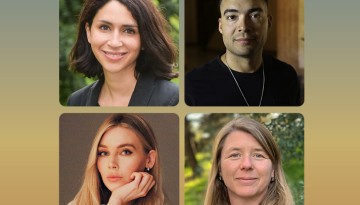
The work of the four winning writers – Andrew Boryga, Aisha Abdel Gawad, C. Michelle Lindley and Amanda Moore – spans a wide range of forms and topics.
Arguing with a conspiracy theorist that the moon landing wasn’t staged is usually a futile effort, but ChatGPT might have better luck, according to new research by Cornell, American University and Massachusetts Institute of Technology psychologists.
Neil Cholli, Klarman Postdoctoral Fellow in economics, has received a grant from the Washington Center for Equitable Growth to study how inequality affects economic growth and well-being in the U.S.
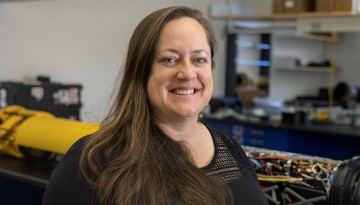
Britney Schmidt, associate professor of astronomy in the College of Arts and Sciences and of earth and atmospheric sciences in Cornell Engineering, has been named a laureate of the Blavatnik National Awards for Young Scientists.
Cornell, the only institution offering regular multilevel instruction in all six of the major Southeast Asian languages – Burmese, Indonesian, Khmer, Filipino (Tagalog), Thai and Vietnamese – will host a conference on the teaching of these languages on Sept. 19-21.
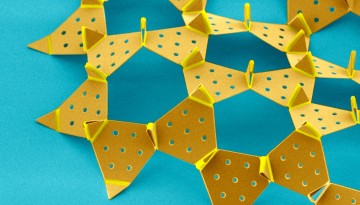
Researchers created a robot less than 1 millimeter in size that is printed as a 2D hexagonal “metasheet” but, with a jolt of electricity, morphs into preprogrammed 3D shapes and crawls.