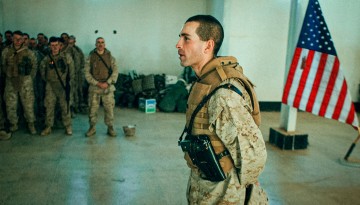
On April 13, the Navy Reserve Officers' Training Corps will celebrate the legacy of U.S. Marine Maj. Richard J. Gannon II '95, nearly 20 years after he was killed in Iraq.
NPR media correspondent David Folkenflik ’91 will lead a panel discussion on the role of dissenting writers in Russia, China, Belarus and elsewhere in a College of Arts and Sciences Distinguished Visiting Journalist Program event on April 17.
A collaboration between two research teams with opposing views found that, despite claims to the contrary, simply reminding people about the concept of accuracy improves the quality of information-sharing on both sides of the political aisle.
Former National Security Advisor Stephen J. Hadley ‘69 will explore “U.S. National Security Policymaking and the Future of U.S.-China Relations” in a fireside chat on Wednesday, April 17.
Alejandro Marin Vidal, ’06, will talk about AI and game creation, industry layoffs and other topics during his talk April 8 at 5 p.m. in Milstein Auditorium in Milstein Hall.
The three-year postdoctoral fellowship, granted to Lígia Fonseca Coelho and Zach Ulibarri, provides recipients with resources, freedom, and flexibility to conduct theoretical, observational, and experimental research in planetary astronomy.