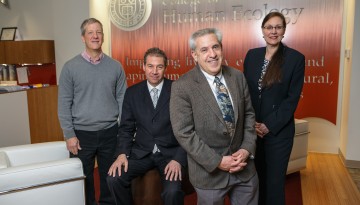
Public service announcements about the dangers of drunken driving could save thousands of lives each year – but only if those ad campaigns are better funded and more people see them, according to three Cornell researchers.
The new theory proposes that vegetarianism is an identity, not just a series of decisions about what to eat. A Cornell undergraduate and his academic adviser came up with the new way to think about vegetarianism.
A multidisciplinary design and research team, assembled to tackle the environmental problem of post-consumer textile waste, has developed a unique fabric-shredding machine called the Fiberizer.
The Institute for the Social Sciences' Small Grants Program is funding a series of critical social science projects and a conference with its spring 2017 awards.
John M. Doris delivered the 10th annual John L. Doris Memorial Lecture hosted by the College of Human Ecology's Bronfenbrenner Center for Translational Research April 12 on campus.
New research by Adam Anderson, professor of Human Development at Cornell’s College of Human Ecology, reveals how the eyes have come to be viewed as windows into the soul.
Sixteen Cornell doctoral students will collaborate with community partners from Ithaca to India on research projects supported by 2017 Engaged Graduate Student Grants.
Ninety-eight Cornell graduate and professional students will travel to 47 countries over the next year with support from the Einaudi Center's International Travel Grant Program.
Four endowed professorships have been established through a challenge grant initiated by longtime Cornell benefactors Joan Klein Jacobs '54 and Irwin Mark Jacobs '54, founding chairman and CEO emeritus of Qualcomm, as part of a $10 million commitment to the college in 2014.