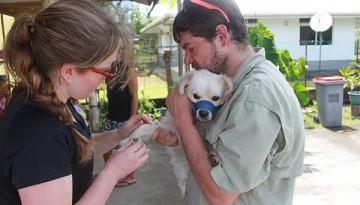
Village dogs from present-day Nepal and Mongolia are direct descendants of the first domesticated dogs, which originated at least 15,000 years ago in that region, a new study reports.
George C. Poppensiek, dean and professor emeritus in the College of Veterinary Medicine, died Sept. 8 in Ithaca. Poppensiek served as dean from 1959 to 1974.
A new reality television series focused on the lives of students at Cornell's College of Veterinary Medicine makes its debut Sept. 19 on National Geographic station.
On her first visit to the New York State Fair, Cornell President Elizabeth Garrett walked past the midway games and deep-fried foods to enjoy the fair’s educational aspects.
The Cornell Weed Science Teaching Garden gives students and the public a chance to recognize species that might harm people or animals, and reduce crop yields.
A program that develops science educational materials that use live Tetrahymena, a single-celled protozoan, to address key biology concepts is expanding, thanks to a five-year, $1.25 million grant.
Michael I. Kotlikoff, the Austin O. Hooey Dean of Veterinary Medicine since 2007, will be Cornell University's 16th provost, President Elizabeth Garrett announced today. Kotlikoff will assume the office Aug. 1.
In a message to faculty and staff, Cornell President Elizabeth Garrett announced the appointment of Michael Kotlikoff as the university's 16th provost.