At this year’s International Conference on Functional Programming (ICFP 2021), the article that announced the network programming language—called Frenetic—at the 2011 meeting was feted as its “Most Influential Paper.”
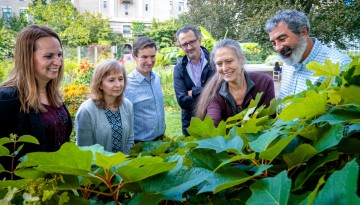
The new Center for Research on Programmable Plant Systems, or CROPPS, funded by a five-year, $25 million National Science Foundation grant, aims to grow a new field called digital biology.
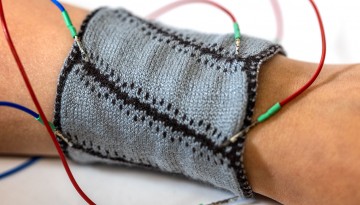
Cindy Hsin-Liu Kao, assistant professor in the College of Human Ecology, uses knitting and weaving techniques to make on-skin devices that express the wearer’s personality.
The Technology and Law Colloquium – a hybrid Cornell University course and public lecture series – returns this semester with talks from 13 leading scholars who study the legal and ethical questions surrounding technology’s impact in areas like privacy, sex and gender, data collection, and policing.
The Cornell Ann S. Bowers College of Computing and Information Science is welcoming 13 new faculty members in the departments of Computer Science, Information Science and Statistics and Data Science. Collectively, their work ranges from developing robots that assist people with mobility limitations to using computational tools to study inequality and graphical models to solve real-world problems.
A Cornell-led collaboration received a $3 million grant from the U.S. Department of Energy to use machine learning to accelerate the creation of low-cost materials for solar energy.
Forty-three high school juniors and seniors teamed up remotely from July 19-23 to build an interconnected system of hardware and software as part of Cornell Engineering’s annual CURIE Academy.
Cornell assistant professors researching artificial intelligence, sustainable energy, digitization in manufacturing and chemistry have recently received early-career awards from the National Science Foundation and the Department of Energy.