More than 100 Cornell faculty and staff members, plus graduate and undergraduate students, explored methods for collecting, sharing, protecting and understanding data in Day of Data, at the ILR Conference Center.
Kirstin Petersen, assistant professor of electrical and computer engineering, is among 22 early-career researchers honored with a Packard Fellowship for Science and Engineering, from the David and Lucile Packard Foundation.
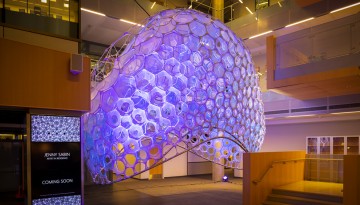
“Ada,” a responsive, photoluminescent fiber pavilion designed by Cornell’s Jenny Sabin, has just opened, suspended in a light-filled atrium at Microsoft Research in Redmond, Washington.
Higher education has been transformed by computing, but technological advances must incorporate human needs, according to university administrators at a panel on the role of technology in education.
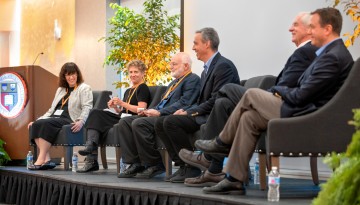
Speakers at the “Creating CIS: Fireside Chat,” which launched Computing and Information Science’s 20th anniversary celebration on Oct. 2, discussed the societal changes they foresaw at the time – as well as those they didn’t see coming.
As the Faculty of Computing and Information Science celebrates its 20th year, Frank Rosenblatt’s prescient research into artificial intelligence underscores Cornell’s pivotal role in computing history.
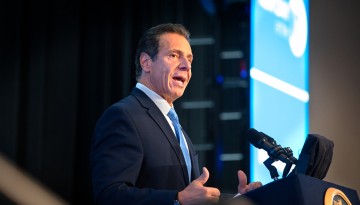
The “New Day at the MTA” conference, co-sponsored by the Metropolitan Transportation Authority, the Jacobs Technion-Cornell Institute at Cornell Tech and the Empire State Development Corporation, explored solutions for an aging transit system that moves 8.6 million people a day.
Silvia Ferrari, the John Brancaccio Professor of Mechanical and Aerospace Engineering, has been awarded a grant to study the brains of moths with the goal of improving drone flight.
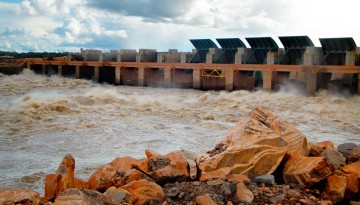
A Cornell-led team has developed a computational model that uses artificial intelligence to find the most sustainable configurations of hydropower dam sites in the Amazon basin.