Artificial intelligence-powered writing assistants that autocomplete sentences or offer “smart replies” not only put words into people’s mouths, they also put ideas into their heads, according to new research.
A new cycle of Einaudi Center seed grants will help faculty from six colleges across Cornell tackle issues ranging from the health of endangered wild dogs to the spread of misinformation through social media.
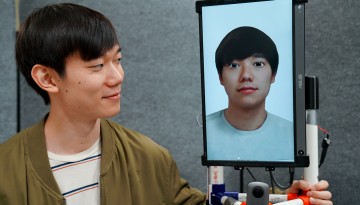
Cornell researchers have developed a robot called ReMotion that occupies physical space on a remote user’s behalf, automatically mirroring the user’s movements in real time and conveying key body language that is lost in standard virtual environments.
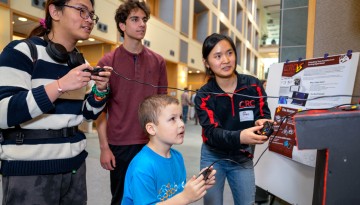
Bits On Our Minds technology showcase, held April 27 in the Duffield Hall atrium, featured cutting-edge technology projects from across the university.
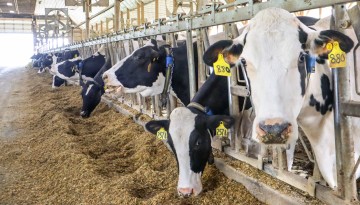
Cutting-edge, data-driven agricultural technologies and precision management strategies designed for the farm of the future will be developed, evaluated and demonstrated, thanks to a four-year, $4.3 million U.S. Department of Agriculture grant.
Cornell is one of six universities receiving a total of $20 million over five years to form an institute aiming to create more climate-smart practices that will curb greenhouse gas emissions while boosting the agriculture and forestry industries.
Cornell Engineering has announced the winners of its seventh annual Engineering Innovation Competition, which recognizes innovative product concepts and prototypes from students.
New grants from the Cornell Center for Social Sciences (CCSS) will fund research ranging from exploring why people spread polarizing content online to assessing health care access in rural New York.
Cornell’s American Indian and Indigenous Studies Program and the Redistributive Computing Systems Group (RCSG) will present a series of talks this Friday exploring the intersection of Indigenous worldviews and computational technologies.