The USDA and the NSF have awarded a three-year, $2.4 million grant to a team of Cornell researchers who will study how ag-to-energy land-use conversions could impact food production.
The health of Earth’s oceans is rapidly worsening, and newly published Cornell-led research has examined changes in reported diseases across undersea species at a global scale over a 44-year period.
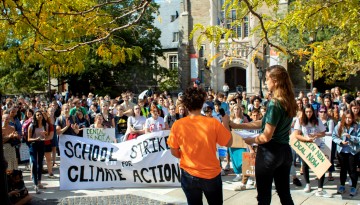
Cornell students participated in a weeklong kaleidoscope of climate change-awareness that involved strikes, symposia and meeting world leaders in New York City.
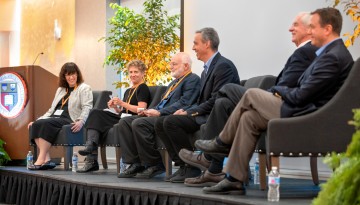
Speakers at the “Creating CIS: Fireside Chat,” which launched Computing and Information Science’s 20th anniversary celebration on Oct. 2, discussed the societal changes they foresaw at the time – as well as those they didn’t see coming.
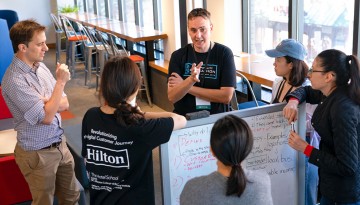
A proposed app enhancement to help hotel guests select rooms matching their preferences earned a team of Cornell freshmen the $3,000 grand prize at the Hilton Hospitality Hackathon held Sept. 20-22.
The second annual Intercampus Cancer Symposium, Oct. 11 at the Cornell College of Veterinary Medicine, will highlight the wide range of cancer research taking place at Cornell’s Ithaca campus and at Weill Cornell Medicine in New York City.
New Cornell research is pointing the way toward an elusive goal of physicists – high-temperature superfluidity – by exploring excitons in atomically thin semiconductors.
This year’s Innovative Teaching and Learning Award winners will give Cornell students a host of new opportunities and experiences, thanks to faculty grants ranging from $5,000 to $25,000.
Twenty-four faculty members, representing six colleges and the Cornell University Library, make up the 2019-20 cohort of the Engaged Faculty Fellowship Program.