Darrell Schlom, the Herbert Fisk Johnson Professor of Industrial Chemistry in the Department of Materials Science and Engineering, has been elected a member of the National Academy of Engineering.
Finding new ways to study cancer and how it spreads is the goal of the Center on the Physics of Cancer Metabolism, a new translational research program between the College of Engineering and Weill Cornell Medicine.
A Cornell water sensor technology that began as basic research is blooming into a business that fills a vital need for grape, nut, apple and other growers.
An 18-foot-long pod engineered by a team that included Cornell students was put to the test during Hyperloop Competition Weekend, Jan. 27-30, at the SpaceX headquarters in Hawthorne, California.
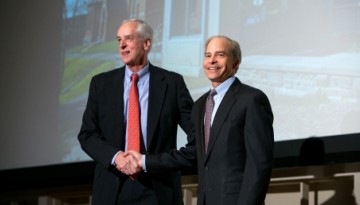
Warm anecdotes of the Johnson family's long and inspiring engagement with Cornell set the tone of a "thank you" event Jan. 31, celebrating the recent $150 million gift from Fisk Johnson and SC Johnson.
Robert F. Smith '85 has been named the Cornell Entrepreneur of the Year 2017. He will be honored Nov. 3 during Cornell’s annual Entrepreneurship Summit in New York City.
Peter DelNero, doctoral candidate in biomedical engineering, received the 2017 K. Patricia Cross Future Leaders Award for his teaching and creation of a program connecting cancer patients to research.
The $150 million gift given by Fisk Johnson and his company to endow the Cornell SC Johnson College of Business marks the latest chapter in a relationship between the Johnson family and Cornell University that extends more than 120 years.