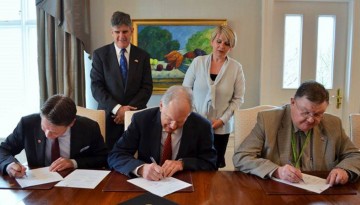
With an aim to create clean, renewable geothermal energy projects, and to cooperate in research and education, Cornell and Geothermal Resource Park Iceland have signed a memorandum of agreement.
Three student fellows recently joined the staff of Blackstone LaunchPad and are already offering innovative programming for entrepreneurial Cornell students.
Emeritus professor Tobias de Boer, who taught mechanical and aerospace engineering at Cornell for more than 50 years and served as associate director of the Sibley School for nine years, died on May 2 at age 85.
Dan Huttenlocher, founding dean and vice provost of Cornell Tech, talked to Ithaca area business leaders on May 3 regarding the state of the school's campus, under construction on Roosevelt Island.
Twenty-one students from across campus traveled to Japan on a a winter break study tour funded by the Japanese government as a cultural exchange exposing American students to the country.
Fifteen Cornell students received Fulbright U.S. Student Awards to conduct research or teach abroad in 2016-17, according to the Mario Einaudi Center for International Studies.
Minglin Ma, assistant professor in the Department of Biological and Environmental Engineering, has won a Hartwell Individual Biomedical Research Award, worth $300,000 over three years.
A Cornell-led international team of researchers has developed a way to harden natural calcite by a factor of two or more through the addition of amino acids aspartic acid and glycine.