Cornell is a global leader in sustainability and climate change research, teaching and engagement. Our campuses are living laboratories for developing, testing and implementing solutions that address these most challenging issues.


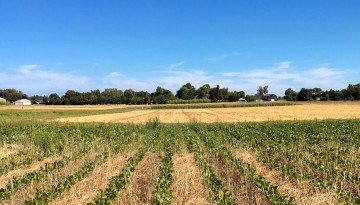
Top ag schools joining forces at Cornell digital ag hackathon

Students and faculty from the world’s five leading agricultural universities, including Cornell, will spend three days learning and brainstorming at the Cornell Initiative for Digital Agriculture’s second annual hackathon, Feb. 28-March 1.

Fossil fuel divestment: An FAQ for the Cornell community

Cornell’s shared governance groups are considering resolutions related to the divestment of fossil fuel-related holdings from the university’s endowment.

Global startup summit taps Zymtronix as challenge finalist

Startup Zymtronix – an industrial biotech company housed in Cornell’s McGovern Center – has been selected as a challenge finalist at the Hello Tomorrow 2020 global summit, March 11-13 in Paris.

Around the world, Cornell fellows guide climate action

Nearly 70 professionals from around the world have become Cornell Climate Online Fellows, as they take action locally to battle atmospheric greenhouse gas and ask others to join in.

Mui Ho Fine Arts Library earns LEED Gold certification

Cornell’s Mui Ho Fine Arts Library in Rand Hall earned the U.S. Green Building Council’s Leadership in Energy and Environmental Design Gold certification in late January.

‘Borehole of opportunity’ attracts international scientists

An international collective of scientists gathered at Cornell to discuss collecting research data from the proposed Earth Source Heat test well in Snee Hall, Jan. 8-10.

Cornell co-leads effort to use big data to combat catastrophes

An NSF-funded initiative, co-led by professor David S. Matteson, aims to harness data across disciplines in order to identify risk factors for catastrophic events.

Genetics, not field conditions, makes hemp ‘go hot’

Cornell researchers have determined that a hemp plant’s propensity to “go hot” – become too high in THC – is determined by genetics, not as a stress response to growing conditions.

Energy-saving particle accelerator achieves breakthrough

A new breed of accelerator, developed at Cornell’s Wilson Synchrotron Lab, provides particle beams with unprecedented properties and power.