Cornell is a global leader in sustainability and climate change research, teaching and engagement. Our campuses are living laboratories for developing, testing and implementing solutions that address these most challenging issues.

Atkinson Academic Venture Fund awards $1.3M to 10 projects

The Atkinson Center is awarding more than $1.3 million in seed grants to support roughly a dozen interdisciplinary research collaborations at Cornell that address key sustainability challenges.

Cornell team, EPA to partner on emissions big data project

Max Zhang and students will work with EPA experts over the next year on a machine learning model to predict fossil fuel emissions.

CALS program educates onion farmers to fight pests, cut chemical sprays

A common onion pest was wreaking havoc on New York state onion crops, but Brian Nault of Cornell AgriTech developed a science-based strategy that has decreased pesticide use and improved onion quality.

Art-science collaboration spotlights pollinator health

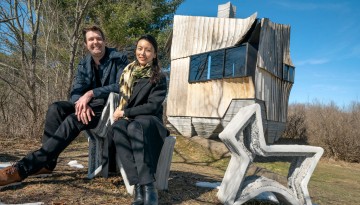
The Mann Library exhibit, “PolliNation: Artists and Scientists Crossing Borders to Explore the Value of Pollinator Health,” bring the serious issue of insect decline to the university community.

Heat, not drought, will drive lower crop yields, researchers say

New research from Ariel Ortiz-Bobea, Toby Ault and Carlos Carrillo in Environmental Research Letters looks at how heat stress remains the primary climatic driver of lower future agriculture yields under climate change.

Winter could pose solar farm ‘ramping’ snag for power grid

While solar farms help summer electricity demand, Cornell engineers caution that upstate winters could prompt “ramping” – bursts of sudden increases or decreases in electricity demand.

Cornell’s food systems students detail experiences in book

The students in Cornell’s first two cohorts of the community food systems minor now have global experience in the world of sustenance, which they’ve shared in a book, “In the Field.”

Cornell to host national Science Olympiad

About 2,000 middle and high school students will show their science and engineering acumen at the 35th annual Science Olympiad National Tournament, May 31-June 1 at Cornell.

Engineered bacteria could be missing link in energy storage

Engineered microbes could be part of a solution for storing energy from sustainable sources, according to new research.