Cornell is a global leader in sustainability and climate change research, teaching and engagement. Our campuses are living laboratories for developing, testing and implementing solutions that address these most challenging issues.


‘Toolkit’ aids sustainable manufacture of medicines

A new technique that combines electricity and chemistry offers a way for pharmaceuticals to be manufactured in an easily scaled-up and sustainable way.

Atkinson Center names 2018-19 SSHA faculty fellows

Cornell’s Atkinson Center for a Sustainable Future has named seven social sciences, humanities and arts (SSHA) fellows for the 2018-19 academic year.

Scientists seek to untangle ecological effects of water management

Cornell and Paleontological Research Institution scientists dug into the Colorado River's estuary mudflats to learn how upstream dams affect downstream mollusks. 

Visitors avoid national parks when air pollution is high

Visitors tend to avoid national parks when air pollution levels are high, according to a Cornell researcher and his colleagues. The work suggests better air quality at national parks could improve human health.

Carnivorous plant inspires sustainable mosquito-control device

A Cornell team has been named a winner in a global competition to create radically sustainable environmental solutions inspired by the natural world.

Cornell professors contribute to winning offshore wind energy alliance

Three Cornell professors contributed to the successful proposal to lead a new $18.5 million endeavor to enhance the United States’ wind-energy economy and nix greenhouse gas emissions.

Bt eggplant improving lives in Bangladesh

Bt eggplant, or brinjal as it’s known in Bangladesh, is the first genetically engineered food crop to be successfully introduced in South Asia.

Upson Hall makeover achieves LEED platinum

The completely reconstructed Upson Hall – for 60 years an anchor on the Engineering Quad and home to the Sibley School of Mechanical and Aerospace Engineering – has been certified LEED Platinum.

Dairy barn implements poop-to-power system

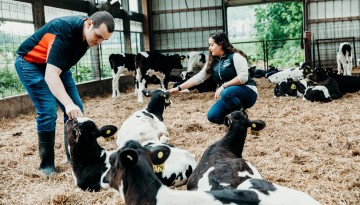
Cornell’s College of Veterinary Medicine Teaching Dairy Barn has installed a system that separates manure from sand bedding that is healthier for cows and creates muck perfect for making electricity.