Cornell is a global leader in sustainability and climate change research, teaching and engagement. Our campuses are living laboratories for developing, testing and implementing solutions that address these most challenging issues.


CURB galvanizes Puerto Rican students’ lab experience

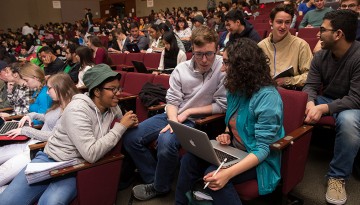
Visiting students from hurricane-ravaged Puerto Rico honed their science skills by shadowing and working in laboratories across campus this semester.

Self-assembling 3D battery would charge in seconds

Uli Wiesner and collaborators have developed a block copolymer self-assembled 3D energy storage architecture that could help change the way batteries are constructed.

Atkinson Center brainstorms solutions for carbon removal

An Atkinson Center workshop May 4 looked for ways to use Cornell research to draw carbon out of the air and oceans and sequester it. 

Cornellians pitch in to update federal flood guide

The U.S. Geological Survey’s “Guidelines for Determining Flood Flow Frequency” has been updated, thanks to a large group of Cornellians.

Two Cornell-related teams chosen as ‘Reimagine the Canals’ finalists

Two Cornell teams are finalists in the Reimagine the Canals competition, a $2.5 million New York state contest that aspires to return the 200-year-old Erie Canal into an economic catalyst and tourism hotspot.

Forum on geothermal energy project set for May 17

A public forum Thursday, May 17, will provide an update on an enhanced geothermal energy system to heat the Ithaca campus sustainably without the use of fossil fuels.

How will New Yorkers power through future hurricanes?

A new paper shows the changing climate’s impact on New York City’s transportation energy infrastructure is worsening over time. 

Helbling lab receives DOD funds to nix nasty chemicals from groundwater

Damian Helbling of civil and environmental engineering has received a three-year, $750,000 grant from the U.S. Department of Defense to conduct research that may rid groundwater of toxic chemicals.

Seniors aim to artfully dodge Texas storm swells

Cornell landscape architecture seniors are working side by side with the U.S. Army Corps of Engineers to integrate ecology and engineering performance to protect Galveston Bay in Texas.