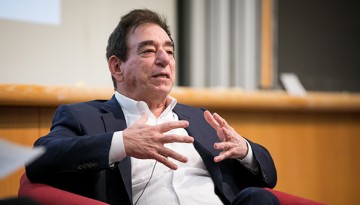
Dr. Leonard Schleifer ’73, the 2019 Cornell Entrepreneur of the Year, shared the successes and failures he experienced while growing his biotechnology company, Regeneron, during an April 11 conversation with Lance Collins, the Joseph Silbert Dean of Engineering.
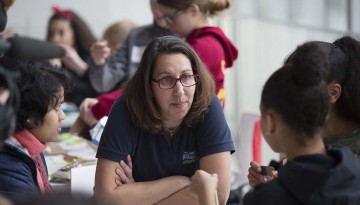
Cornell Tech’s Teacher in Residence program, which provides coaching to help public school teachers incorporate computer science into the school day, will expand into four additional schools in New York City.
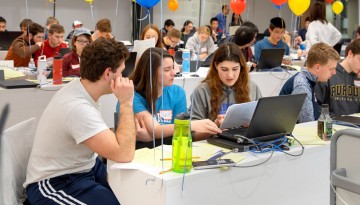
More than 180 students competed in Cornell’s annual High School Programming Contest, held simultaneously at Cornell Tech and in Rhodes Hall on the Ithaca campus.
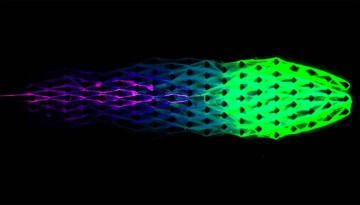
Cornell engineers have constructed a DNA material with capabilities of metabolism, in addition to self-assembly and organization – three key traits of life.
Social Enterprise at Cornell hosted the first Startup Career Fair at Cornell March 27 to match local socially conscious startups with students seeking summer internships.
Ten Cornell faculty members in computer science and engineering have received Google Faculty Research Awards. Cornell has the third-highest number of recipients among the 80 institutions worldwide that received Google awards.
Cornell researchers have discovered a way to accelerate photons using four orders of magnitude less energy than existing methods, paving the way for ultraviolet lasers that can capture processes lasting a quintillionth of a second.
Researchers have developed a mathematical model to calculate blameworthiness on a scale from zero to one – a tool that potentially could be used to guide the behavior of artificially intelligent agents, such as driverless vehicles, to help them behave in a “moral” way.