Cornell climate scientists and their colleagues have developed a “robust null hypothesis” to assess the odds of a megadrought – one that lasts more than 30 years – occurring in the western and southwestern United States.
The leadership group has been selected for the newly formed Earth Source Heat planning committee, part of the campus effort to achieve carbon neutrality by the year 2035.
Engineer Max Zhang makes a concerted effort to improve the world through collaboration. “Ideas will only stay in my lab, will only stay on paper, if we don’t engage or work with the community.”
A new wrinkle for the final project in Hadas Kress-Gazit's Mechatronics class had students building autonomous robots that competed in a game called Cube Craze.
Cornell engineers and nutritionists have created a swift solution for a challenging global health problem: a low-cost, rapid test to detect iron and vitamin A deficiencies at the point of care.
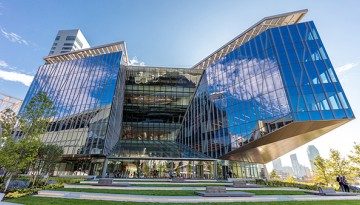
Tata Consultancy Services, a leading global IT services, consulting and business solutions organization, announced Dec. 4 a $50 million investment in Cornell Tech. The investment includes a significant gift for the first phase of capital development on the Roosevelt Island campus.
A Cornell student, representing global youth constituencies at the Conference of the Parties (COP23) in Bonn, Germany, delivered a strong climate change statement to the convention delegates.
Cornell engineering students are creating a state-of-the-art computer model to strategically place trees on highways near residential areas to mitigate pollution particles and improve human health.