Sixteen student project teams in the College of Engineering hone their entrepreneurial skills by building vehicles and other projects to enter national competitions.
Solving the world's energy problems isn't just about research into new technologies, and neither is Cornell research on sustainability, a group of experts told Cornell engineering alumni.
Lenses and prisms for electron waves, combined mechanical and optical oscillators and terahertz frequency generators are 'high-risk' projects at Cornell receiving DARPA Young Faculty Awards. (April 1, 2008)
The Cornell NanoScale Science and Technology Facility will host a workshop and networking reception to highlight success stories from nanotechnology ventures and small-business grants. (April 1, 2008)
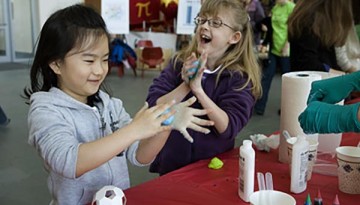
Local children of all ages learned about nanotechnology March 30 by making slime, extracting salmon DNA and attending workshops at Cornell's NanoDay, an open house in Duffield Hall.
Many Cornell students gave up beach parties for work parties during spring break not only in New Orleans, but in Boston, Orlando and rural West Virginia.
Matthew DeLisa, assistant professor of chemical and biomolecular engineering, has received the inaugural Daniel I.C. Wang Award, sponsored by John Wiley & Sons Inc. and by the journal Biotechnology and Bioengineering. (March 19, 2008)
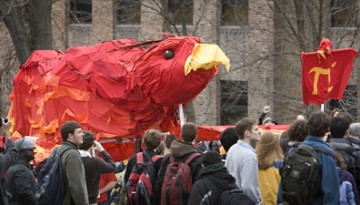
Engineering students revived the tradition of creating a phoenix float to confront the dragon as it passed the Engineering Quad on Dragon Day 2008. (March 14, 2008)