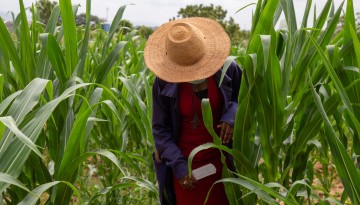
Two Cornell alumni with deep ties to plant breeding efforts in Africa were recognized for outstanding work building capacity to improve food security on the continent.
Ronnie Coffman, Ph.D. ’71 and Joe DeVries, Ph.D. ’95 received…
To reduce global atmospheric greenhouse gas, Cornell food systems expert Mario Herrero shows how China must develop more sustainable, international agricultural trade.
"We Love We Self Up Here" is a documentary film that's an extension of Cornell's fall 2019 Mellon Collaborative Seminar titled Atmospheric Pressures: Climate Imaginaries and Migration in the Caribbean.
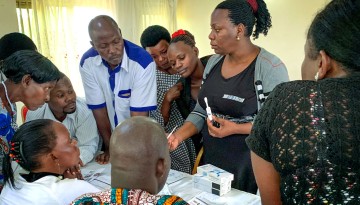
Partnering with traditional healers improves uptake of HIV tests in rural Uganda, according to a trial by Weill Cornell Medicine and Mbarara University of Science and Technology investigators.
Described as “an anthropology of labor that is sharply attuned to the irreversible effects of climate change, extinction, and deforestation,” book wins Society for the Anthropology of Work Book Prize.
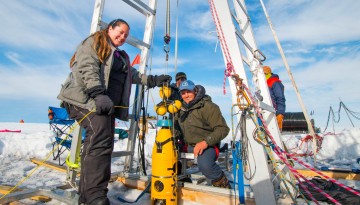
To prep for missions to Jupiter’s icy moon Europa, Britney Schmidt, associate professor of astronomy and earth and atmospheric sciences, is studying Antarctica’s ice and oceans.
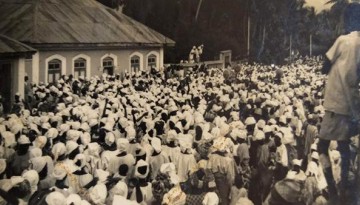
A new book by Judith Byfield, professor of history, highlights the central role that women played in Nigeria’s nationalist movement in the years following World War II.
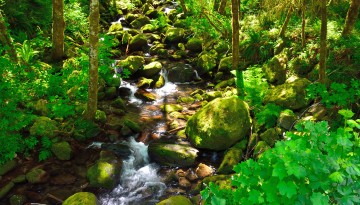
The rocky surface of Earth’s geology may provide a buffer for climate change to absorb excess carbon, according to a new Cornell paper in Global Biogeochemical Cycles.
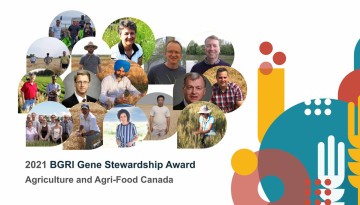
The rust-resistant wheat cultivar development team at Agriculture and Agri-Food Canada (AAFC) earned the Borlaug Global Rust Initiative (BGRI) 2021 Gene Stewardship Award for their long-standing innovations and strategies to…