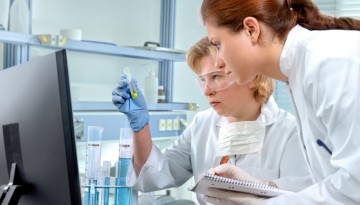
A group led by chemistry professor John Marohn has developed a technique for measuring photocapacitance in an organic polymer solar cell, which could lead to producing better solar-cell compounds.
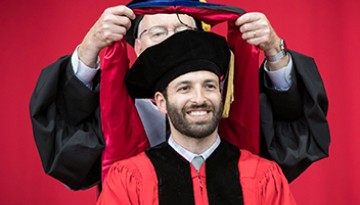
President Martha E. Pollack congratulated about 300 newly minted Ph.D.s in a speech that challenged them to "be an expert in your own discipline," and to "model the ways in which experts think and draw conclusions in everything you do."
Cornell University President Martha E. Pollack's first Commencement address and former U.S. Vice President Joe Biden's Senior Convocation address highlight Cornell's 149th Commencement Weekend, May 27-28.
Cornell Tech's Open Studio, held for the final time at the Google building campus, gives budding entrepreneurs a chance to pitch their ideas to several hundred people, including business leaders.
A research group led by Poul Petersen, professor of chemistry and chemical biology, reports a chiral "spine" of hydration inside DNA, the first report of a chiral water superstructure inside a biomolecule.
A new initiative on academic integration will connect research across Weill Cornell Medicine, Cornell Tech and the Ithaca campus. Dr. Gary Koretzky will lead the effort, which will tie together investigation and discovery.
A Cornell-led group of researchers has developed a method for converting near-infrared light to mid-IR, while retaining the desired shape of the beam and effectively increasing its bandwidth.
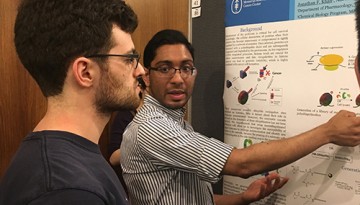
At the 37th Annual Vincent du Vigneaud Memorial Symposium April 18, posters displayed research from students at every stage along the path to a doctorate.
A research team led by chemistry professor Hening Lin has discovered a novel protein post-translational regulatory mechanism that shows promise in suppressing the proliferation of cancer cells.